John of Egypt is a venerable of the Catholic Church (d. 394). John of Egypt's feast day is celebrated on 27 March.
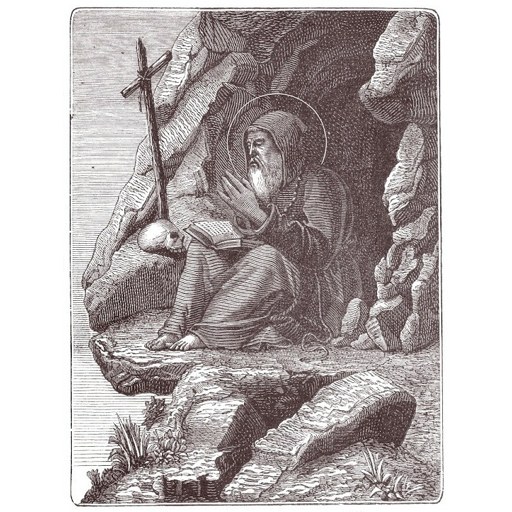
Desconegut
License: CC BY-SA 4.0
John of Egypt
Venerable- Life Span
- d. 394
- Feast Day
- 27 March
- Gender
- male
- Church
- Catholic
Places
Roles & Family
Biography
John of Egypt, also called John of Lycopolis and John the Anchorite, was a Christian hermit of Upper Egypt in the later fourth century and is numbered among the Desert Fathers. The principal ancient witnesses—Palladius of Helenopolis in the Lausiac History, the Greek Historia Monachorum in Aegypto (and Rufinus’s related Latin recension), and later notices in Sozomen and Augustine—present him as a native of Lycopolis, the city now known as Asyut, in the Thebaid. Before he took up the eremitical life he worked as a carpenter. In early adulthood, at about the age of twenty-five according to the traditional accounts, he left his trade and sought formation among the monks of the region, placing himself under an elder who trained him in humility, obedience, and ascetic practice. After a period of this discipleship, and after the death of his master, he withdrew to a mountain near Lycopolis and became a recluse.
There he occupied a cell of three rooms—one used as an oratory, one for work and the taking of food, and one for other bodily needs—and he walled himself in so that he did not leave the enclosure for the remainder of his life. He spoke with male visitors only through a window and would not permit women to see him at all. He is described as living in this confinement for several decades, supporting himself by manual work, eating sparingly and ordinarily only after sunset, and devoting long hours to prayer. Disciples and attendants lived nearby and assisted him, but he himself remained inside the cell. Contemporary visitors portrayed him as the most celebrated monk of the Thebaid in his day.
His fame as a man of prayer, a discerner of thoughts, and a prophet spread through Egypt and reached the imperial court. The emperor Theodosius I is said to have sent messengers to consult him about military undertakings, including the campaigns against the usurpers Magnus Maximus and Eugenius; John predicted success for the emperor in both wars and was also credited with foreknowledge connected with Theodosius’s last years. He was reputed to know distant events and to obtain healings through prayer. Palladius, who visited him in the 390s, recorded that John read his visitor’s unspoken intentions, gave counsel on the monastic life, and spoke of trials that Palladius would one day face in the episcopate. The Historia Monachorum, reflecting a journey of monks associated with the Mount of Olives around the mid-390s, opens with a long account of John. Augustine of Hippo, in The City of God, refers to a John in Egypt of wide reputation for miracles and prophecy, a notice generally taken to concern this hermit.
John left no known writings; what can be said of him depends on these late-fourth- and early-fifth-century witnesses and on the later hagiographical tradition that drew on them. Precise years of birth are not recorded in the early sources; later summaries that give a birth around the first decade of the fourth century rest on statements that he died at an advanced age, not on an independent birth record. He is reported to have died in 394, around the time of Theodosius’s last victory and not long after the visits recorded by Palladius and the authors of the Historia Monachorum. Veneration of him as a saint is already implied by those near-contemporary narratives. In the Roman Martyrology his feast is assigned to 27 March. He held neither papal nor patriarchal office, and he belonged to no later medieval religious order; his historical importance lies in the picture he offers of Theban anchoretic life and of the spiritual authority a walled-up hermit could exercise in the later Roman Empire.