John, of Kyiv Caves is a venerable of the Catholic Church (d. 1160). John, of Kyiv Caves's feast day is celebrated on 18 July and 28 September.
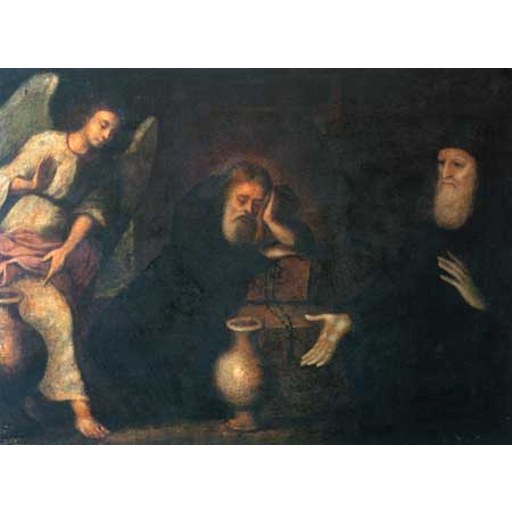
Unknown Orthodox icon painter
License: Public domain
John, of Kyiv Caves
Venerable- Life Span
- d. 1160
- Feast Day
- 18 July and 28 September
- Gender
- male
- Church
- Catholic
Places
Relics & Where to Venerate
Location unknown
The bodily remains of John, of Kyiv Caves are a first-class relic. Venerated at Kyiv Pechersk Lavra.
Roles & Family
Biography
The Kyiv Pechersk Lavra, known in English as the Monastery of the Caves, was established in the mid-eleventh century on the wooded hills above the Dnieper River at Kyiv. Saint Anthony, tonsured on Mount Athos, began the cave-dwelling life there; Saint Theodosius organized the community according to a coenobitic rule influenced by the Studite tradition. By the twelfth century the Lavra was the principal monastic centre of Kievan Rus' and the source of many bishops and of the Kyiv Caves Patericon, a collection of stories about its monks. One of those monks was John, called the Long-Suffering or Much-Suffering, whose memory survives almost entirely within that hagiographic tradition.
The Patericon relates that John was afflicted for many years by intense carnal temptation. Ordinary monastic disciplines of fasting, night vigils, and prayer did not free him. He therefore adopted extreme measures. He excavated a pit in his cave cell and stood in it, covering his body with earth up to the chest, and remained in that posture throughout Great Lent. He also bound himself with heavy iron chains. The account describes repeated attacks by demons, who appeared in the forms of beasts and of men, struck him, and attempted to force him from his place of struggle. John persevered, attributing his eventual deliverance to God and to the intercession of the Mother of God after some thirty years of warfare.
Tradition in the Orthodox Church places his death in the year 1160. His relics were later found and are preserved in the Near Caves, also called the Caves of Saint Anthony, within the Kyiv Pechersk Lavra. Pilgrims have venerated them for centuries. He is commemorated on 18 July and, with the other holy fathers of the Near Caves, on 28 September. Later spiritual writers have pointed to his life as an example of unyielding resistance to lust, though they also note the exceptional, even dangerous, character of his bodily ascesis.
No princely chronicle or other contemporary document independent of the Patericon cycle records John’s name or the date of his death. Like many of the lesser-known cave monks of the Lavra, he is known solely through liturgical commemoration and the patericon narrative. He held no episcopal, patriarchal, or papal office. There is no evidence that he married or had children; the entire surviving tradition presents him as a celibate monastic ascetic. Modern historical study therefore accepts him as a twelfth-century monk of the Kyiv Caves while treating the miraculous and chronological details of his vita with the caution appropriate to medieval hagiography.