John of Nepomuk is a saint of the Catholic Church (d. 1393). John of Nepomuk's feast day is celebrated on 16 May. John of Nepomuk is the patron saint of Bohemia;Czech Republic;Prague;confessors;the seal of confession;bridges;against floods;against drowning;against slander;against calumny;silence;sailors;boatmen.
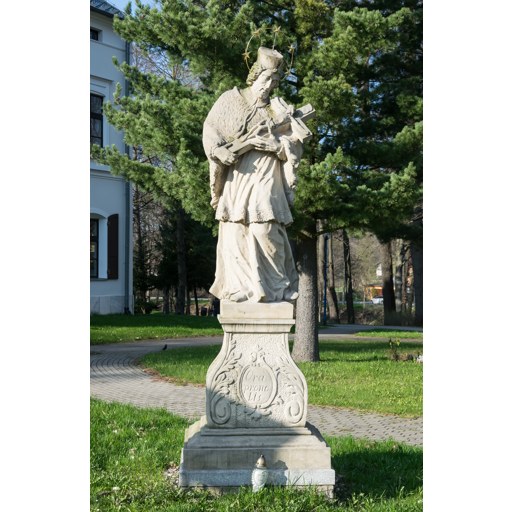
Jacek Halicki
License: CC BY-SA 4.0
John of Nepomuk
Saint- Life Span
- d. 1393
- Feast Day
- 16 May
- Gender
- male
- Church
- Catholic
Places


Relics & Where to Venerate
Location unknown
The bodily remains of John of Nepomuk are a first-class relic. Venerated at St. Vitus Cathedral.
Roles & Family
Patronage
Bohemia;Czech Republic;Prague;confessors;the seal of confession;bridges;against floods;against drowning;against slander;against calumny;silence;sailors;boatmen
Canonization
Biography
John of Nepomuk, known in Czech as Jan Nepomucký, was a priest of the Archdiocese of Prague whose death in 1393 made him one of the most celebrated martyrs of late medieval Bohemia. He was born in the market town of Pomuk (later called Nepomuk) in western Bohemia, then part of the Kingdom of Bohemia in the Holy Roman Empire. Contemporary records identify his father as a local burgher named Welflin. John received a university education at Prague and later at Padua, where he obtained a doctorate in canon law in 1387. In the following years he held a succession of ecclesiastical offices in Prague: he served as a notary in the archepiscopal administration, as a canon of several collegiate churches including St. Vitus Cathedral, and as a parish priest. By the late 1380s Archbishop John of Jenštejn had appointed him vicar-general of the archdiocese, making him the archbishop’s principal deputy in matters of jurisdiction.
The conflict that led to his death arose from a struggle between King Wenceslaus IV of Bohemia and the archbishop over control of church appointments. In 1393 the Benedictine community of Kladruby Abbey elected a new abbot. The king intended to convert the wealthy house into a bishopric for a royal favorite and opposed the monks’ choice. Acting as vicar-general, John of Nepomuk confirmed the lawful election in accordance with canon law. Wenceslaus had John and other officials seized. According to the archbishop’s subsequent report to the papal court, John was tortured—including by burning—and then, on the night of 20 March 1393, thrown bound from the stone bridge of Prague into the Vltava River, where he drowned. This near-contemporary account presents the killing as royal violence against an ecclesiastical officer who had upheld the church’s rights against the crown.
A different explanation of the martyrdom became dominant in later centuries. From the fifteenth century onward, and with particular force during the Catholic Reformation of the seventeenth century, John was portrayed as the confessor of Queen Sophia (Žofie of Bavaria) who had refused to break the seal of confession when the jealous king demanded to know her secrets. That story is not found in the earliest documents and is regarded by historians as a later hagiographical development, yet it shaped his cult: he came to be honored as a martyr of the confessional seal and as a patron of confessors, of silence, and of those calumniated. Jesuit promotion of his cult in Bohemia after the Battle of White Mountain in 1620 made him a central figure of recatholicization and a national saint standing against Hussite and Protestant memory. Legend also associated stars appearing over the river where his body was found, an image that entered his standard iconography.
The Holy See confirmed his cult in the early eighteenth century. He was beatified in 1721 by Pope Innocent XIII and canonized on 19 March 1729 by Pope Benedict XIII. His feast is kept on 16 May. Statues of the saint—typically a bearded priest in biretta and mozzetta, a crucifix in his arms, a finger to his lips, and a halo of five stars—were erected on bridges throughout Central Europe, reflecting both the manner of his death and his patronage against floods and drowning. His principal shrine is the silver tomb in St. Vitus Cathedral in Prague, a major Baroque monument and pilgrimage site. He is invoked as patron of Bohemia and the Czech lands, of bridges, of confessors and the secrecy of the confessional, of those in danger on the water, and of those suffering slander.