John of Réôme is a saint of the Catholic Church (d. 544). John of Réôme's feast day is celebrated on 28 January.
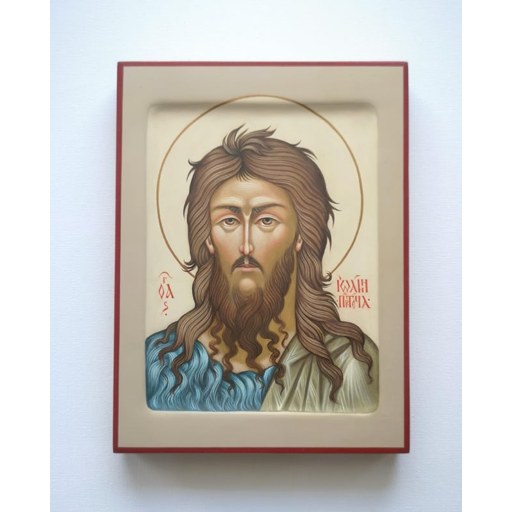
https://reddit.com/r/OrthodoxChristianity/comments/1lgy6zd/handpainted_icon_of_saint_john_the_forerunner_and
License: unknown
John of Réôme
Saint- Life Span
- d. 544
- Feast Day
- 28 January
- Gender
- male
- Church
- Catholic
Places
Roles & Family
Biography
John of Réôme, also known as John of Reomay or Jean de Réôme (Latin: Ioannes Reomaensis), was a Gallo-Roman monk and abbot of the sixth century and the founder of the monastery of Réôme in Burgundy, on the site of the later abbey of Moutiers-Saint-Jean in the present-day Côte-d'Or. Almost all that can be said of his life with any confidence derives from the Vita Iohannis Reomaensis, a Latin life composed about 659 by Jonas of Bobbio, the hagiographer of Columbanus, who wrote at the request of the community of Réôme. Jonas presents John as a native of Dijon (Divio), born of a respectable family, who from an early age was drawn to the ascetic life. No contemporary source records a year of birth; later tradition sometimes assigns a fifth-century date, but that chronology is not independently verified and should be treated with caution.
According to Jonas, John sought monastic formation at the island abbey of Lérins, then one of the most influential monasteries in Gaul and a conduit for Eastern desert spirituality and for a disciplined coenobitic rule. After a period at Lérins he returned north and established a community at Réôme (Reomaus) in the territory of the Lingones, in the diocese of Langres. Some versions of the tradition hold that he first lived as a hermit at that place, that disciples gathered around him, and that he went to Lérins in order to learn a proper monastic rule before returning to organize the house. The community at Réôme became a significant local centre of monastic life. The rule first observed there appears to have been that which John had known at Lérins rather than the Rule of Saint Benedict, which was only beginning to circulate in Gaul in the mid-sixth century; in later centuries the abbey of Moutiers-Saint-Jean followed the Benedictine observance.
Jonas portrays John as a severe ascetic, a father of monks, and a worker of miracles, in keeping with the conventions of seventh-century hagiography. The vita includes accounts of healings and of John’s humility and pastoral care, but these narratives cannot be verified independently and belong to the genre of monastic praise rather than to documentary history. John is not recorded as having held episcopal office, nor as having been married or as having children; the sources present him solely as a consecrated monk and abbot. He is said to have died at an advanced age at his monastery. Medieval martyrologies commemorate him on 28 January. The year of death is conventionally given as 544 (sometimes 539); that figure is traditional rather than established by a contemporary chronicle. He was buried at Réôme.
The cult of John developed around his tomb and was given literary form by Jonas’s vita in the seventh century. The monastery he founded, later known as Moutiers-Saint-Jean (Monasterium Sancti Iohannis), remained an important Burgundian abbey through the Middle Ages, with a notable Romanesque church and a long Benedictine history until the early modern period. John was never the subject of a formal papal canonization of the later medieval type; his sainthood rests on ancient local veneration and liturgical commemoration, as is typical for Gallic monastic founders of the sixth century. He is not widely invoked as a patron of particular places, professions, or causes beyond the association with his own monastery. Modern historical knowledge of him remains limited to Jonas’s text, later martyrological notices, and the archaeological and documentary history of Moutiers-Saint-Jean.