John of Shanghai and San Francisco is a saint of the Catholic Church (1896 - 1966). John of Shanghai and San Francisco's feast day is celebrated on 2 July.
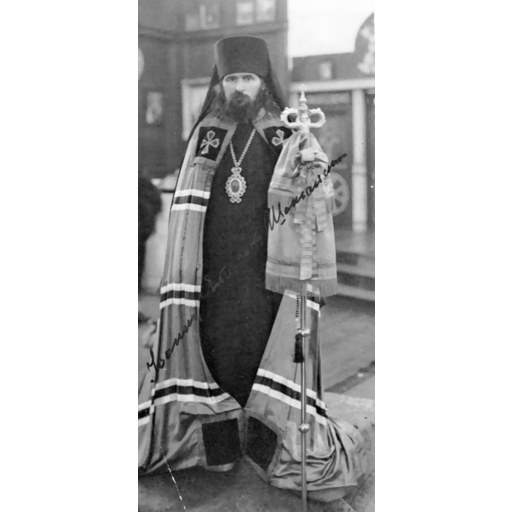
AnonymousUnknown author
License: Public domain
John of Shanghai and San Francisco
Saint- Life Span
- 1896 - 1966 (age 70)
- Feast Day
- 2 July
- Gender
- male
- Church
- Catholic
Places
Relics & Where to Venerate
Location unknown
The bodily remains of John of Shanghai and San Francisco are a first-class relic. Venerated at California.
Roles & Family
Canonization
Biography
John of Shanghai and San Francisco was born Mikhail Borisovich Maximovitch on 4 June 1896 in the village of Adamovka in the Kharkov Governorate of the Russian Empire, in what is now eastern Ukraine. He belonged to a pious noble family and was a descendant of Saint John Maximovitch of Tobolsk, an eighteenth-century metropolitan. After a military education at the Poltava Cadet Corps he studied law at Kharkov Imperial University. The revolutions of 1917 and the Russian Civil War drove the family into exile in the Kingdom of Serbs, Croats and Slovenes, where he completed theological studies at the University of Belgrade in 1925.
In 1926 Metropolitan Anthony (Khrapovitsky) tonsured him a monk with the name John, in honor of his sainted ancestor, and ordained him hierodeacon and then hieromonk. From 1929 he taught at the Serbian Orthodox seminary in Bitola, where he was known for ascetic life and care for students. In 1934 the Synod of Bishops of the Russian Orthodox Church Outside Russia consecrated him Bishop of Shanghai. There he organized parish life for a large Russian émigré population, founded the Saint Tikhon of Zadonsk Orphanage for abandoned children, visited the sick daily, and became renowned for severe personal austerity, including taking only brief rest in a chair rather than a bed. He remained with his flock through the Japanese occupation of China and was elevated to archbishop in 1946.
When Communist forces approached Shanghai in 1949, he organized the departure of approximately five thousand Orthodox refugees to a camp on the island of Tubabao in the Philippines and stayed with them until they obtained permission to emigrate to the United States and Australia. In 1951 he was appointed Archbishop of Western Europe, residing in Paris and later Brussels, and oversaw scattered Russian parishes as well as a number of Western-rite Orthodox communities. In 1962 the Synod assigned him to the Diocese of San Francisco, then divided by conflict over its unfinished cathedral. He completed the Cathedral of the Mother of God Joy of All Who Sorrow and worked to restore peace in the parish while continuing his lifelong practice of frequent liturgies and visits to the sick.
On 2 July 1966, while accompanying the Kursk-Root Icon of the Mother of God on a pastoral visit to Seattle, he died in his room after serving the liturgy. His body was brought back to San Francisco and buried in a crypt beneath the cathedral. Accounts of miracles and of the incorruption of his relics circulated widely among the Orthodox. The Russian Orthodox Church Outside Russia glorified him as a saint in 1994; after the restoration of canonical communion in 2007, the Moscow Patriarchate likewise authorized his general veneration. His relics remain enshrined in the San Francisco cathedral and continue to attract pilgrims.