John of Vercelli is a blessed of the Catholic Church (1205 - 1283). John of Vercelli's feast day is celebrated on 1 December.
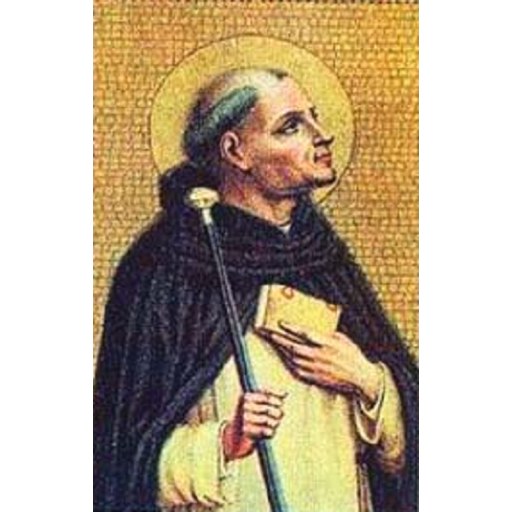
Unknown authorUnknown author
License: CC BY-SA 4.0
John of Vercelli
Blessed- Life Span
- 1205 - 1283 (age 78)
- Feast Day
- 1 December
- Gender
- male
- Church
- Catholic
Places
Roles & Family
Religious Information
Canonization
Biography
John of Vercelli, known in Italian as Giovanni da Vercelli and in some later accounts as Giovanni Garbella, was a thirteenth-century friar of the Order of Preachers and the sixth Master General of that order. He was born about 1205 at Mosso Santa Maria, a mountain community in the Biellese district of Piedmont, then in the diocese of Vercelli. Of a family able to provide him with an advanced education, he studied civil and canon law and is reported to have obtained the doctorate. He taught law, according to the tradition of the order, before taking the Dominican habit, most likely at the convent of Vercelli, in the later 1220s. Thereafter he taught in Dominican schools, notably at Bologna, a centre of legal and theological study, and he served as prior of the Bologna convent. Those years formed him as a preacher, superior, and man of affairs in the communal world of northern Italy.
In 1257 he was elected prior provincial of the province of Lombardy, a vast jurisdiction that included the Dominican houses of much of northern Italy and that was continually affected by the wars of the communes and by the struggle between papacy and empire. As provincial he conducted regular visitations, sought to maintain observance of the constitutions, and represented the order in dealings with bishops and civic authorities. When Humbert of Romans, the fifth Master General, resigned, the general chapter meeting at Paris in 1264 elected John to succeed him. He held the master generalship for nineteen years, until 1283. During that long government he visited many provinces in person, defended the order’s privileges, promoted study in the studia generalia, and kept in force the liturgical and legislative corpus that Humbert had completed. The order continued to grow in numbers and in geographical reach under his leadership.
The papacy repeatedly drew on his legal training and his standing among the mendicants. Urban IV, Clement IV, Gregory X, Nicholas III, and Martin IV used him in missions of peace and reform, above all in Lombardy, where factional violence constantly threatened the church’s freedom and the security of religious houses. Gregory X instructed John to preach peace among the Italian cities and to spread devotion to the Holy Name of Jesus. Dominican tradition, followed by later Holy Name societies, regards John as a principal organizer of that devotion within the order’s apostolate. In 1274 he took part in the Second Council of Lyons, summoned by Gregory X to promote reunion with the Byzantine church, to aid the Holy Land, and to reform Christian life. At Lyons the council fathers confirmed the place of the Dominican and Franciscan orders; John’s presence there placed him among the leading religious superiors of the age, in the same generation as Thomas Aquinas, who died on the journey to the council, and Bonaventure, who died while the council was in session.
John of Vercelli died at Montpellier on 30 November 1283, in the course of a journey in southern France connected with the government of the order. He was buried in the Dominican church of Montpellier. Memory of his government and of his reputation for prudence and zeal was preserved in the Order of Preachers. In 1903 Pope Pius X confirmed his ancient cult, an act accepted as beatification, and he is venerated in the Catholic Church as Blessed John of Vercelli. His feast is observed on 1 December, the day following the anniversary of his death, which coincides with the feast of Saint Andrew. He remains a representative figure of the second generation of Dominicans: a university-trained lawyer who became a friar, a provincial and master general in an age of communal strife, and a collaborator of the reforming popes of the later thirteenth century.