John Ogilvie is a saint of the Catholic Church (1579 - 1615). John Ogilvie's feast day is celebrated on 10 March. John Ogilvie is the patron saint of Scotland.
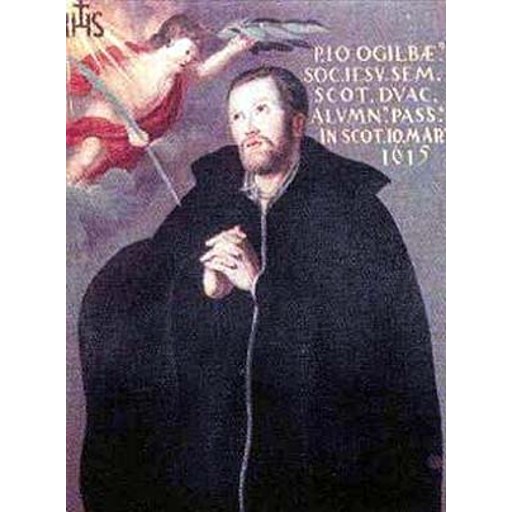
Unknown authorUnknown author
License: Public domain
John Ogilvie
Saint- Life Span
- 1579 - 1615 (age 36)
- Feast Day
- 10 March
- Gender
- male
- Church
- Catholic
Places
Roles & Family
Religious Information
Patronage
Scotland
Canonization
Biography
John Ogilvie was born in 1579 at Drum-na-Keith, near Keith in Banffshire in northeastern Scotland, the son of Walter Ogilvie, a member of the local landed gentry. His family was Calvinist, in keeping with the established Protestant religion of post-Reformation Scotland. As a boy he was sent to the European continent for his education, a path taken by many sons of Scottish families of standing. He studied for a time in Lutheran Germany, including at Helmstedt, and later in the Low Countries. During these years abroad, in the mid-1590s, he converted to Roman Catholicism, a decision that set him at odds with the law and religious settlement of his homeland. He continued his studies at Catholic colleges associated with the Scottish exile community, including at Douai and in Moravia.
Toward the end of the sixteenth century he entered the Society of Jesus in the Jesuit province that covered the Habsburg lands of central Europe, beginning his novitiate at Brno. After the long Jesuit formation in philosophy and theology, including time at Graz, he was ordained a priest in Paris in 1610. The Catholic mission to Scotland was then among the most hazardous in Europe: saying Mass, reconciling penitents, and even possessing Catholic objects could be treated as crimes, and priests who returned from abroad faced the possibility of arrest and death. After a period of ministry in France, Ogilvie received permission to join the Scottish mission and landed in Scotland in 1613, traveling under an assumed name and in secular dress. He worked in secret in the east and west of the country, particularly in Edinburgh and Glasgow, celebrating the sacraments in private houses and encouraging Catholics who had little access to priests.
In October 1614 he was arrested in Glasgow after being betrayed to the authorities. He was examined by John Spottiswoode, the Protestant Archbishop of Glasgow, and by officers of the crown, who pressed him to acknowledge the spiritual supremacy of King James VI and I and to reveal the names of those who had heard his Masses or given him shelter. Ogilvie refused both. He was subjected to harsh interrogation and torture, including prolonged sleep deprivation. Transferred between Glasgow and Edinburgh, he was eventually tried on a charge of high treason for denying the king's authority in spiritual matters and upholding that of the pope. He was found guilty. On 10 March 1615 he was hanged at Glasgow Cross. Contemporary accounts describe him as meeting death with composure, praying for the king and for his executioners. He was in his mid-thirties. As a condemned traitor he was denied honorable burial, and the site of his grave has not been identified with certainty.
Scottish and Jesuit Catholics remembered Ogilvie as a martyr of the Reformation era. His cause was advanced in the modern period: he was beatified by Pope Pius XI on 16 December 1929 and canonized by Pope Paul VI on 17 October 1976, becoming the first Scottish saint of the post-Reformation period to be formally canonized by the Catholic Church. A cure from cancer attributed to his intercession, involving a Glasgow man in the 1960s, was accepted in the canonization process. His feast day is observed on 10 March. He is venerated especially in Scotland, where he is often invoked as a patron of the country, and churches and schools have been dedicated to him, notably in Glasgow and elsewhere in the west of Scotland.