Jonah of Kiev is a saint of the Catholic Church (d. 1461). Jonah of Kiev's feast day is celebrated on 31 March, 27 May, 15 June.
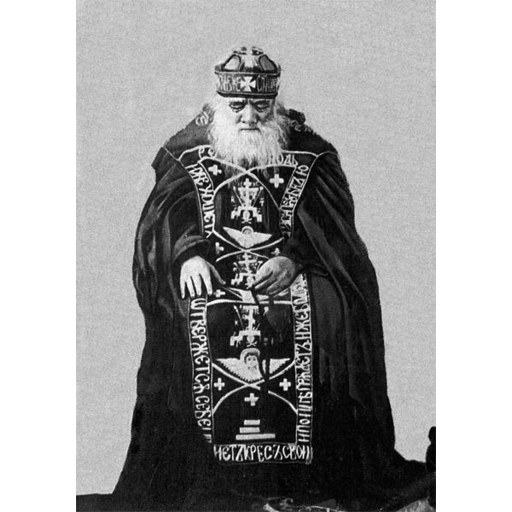
Unknown city photographer
License: Public domain
Jonah of Kiev
Saint- Life Span
- d. 1461
- Feast Day
- 31 March, 27 May, 15 June
- Gender
- male
- Church
- Catholic
Places
Relics & Where to Venerate
Location unknown
The bodily remains of Jonah of Kiev are a first-class relic. Venerated at Trinity Monastery of St. Jonas.
Roles & Family
Canonization
Biography
Saint Jonah, Metropolitan of Kiev and All Rus', was a fifteenth-century hierarch whose installation in Moscow is conventionally taken as the beginning of the autocephaly of the Russian Orthodox Church. He was born in the late fourteenth century in the village of Odnoushevo, in the Galich-Soligalich region of the Grand Duchy of Moscow. Neither his baptismal name nor an exact year of birth is preserved in reliable sources. He entered monastic life in youth, living first in a monastery of the Galich country and afterward at the Simonov Monastery in Moscow. According to the later Life, Metropolitan Photius of Kiev, visiting Simonov, pointed out the monk Jonah and predicted that he would become metropolitan.
After Photius died in 1431, Grand Prince Vasily II of Moscow regarded Jonah as the preferred candidate for the vacant see, but Constantinople appointed others, among them the Greek Isidore. Jonah was made bishop of Ryazan and Murom and administered that diocese for some years. Isidore accepted the Union of Florence in 1439; when he returned to Moscow in 1441 and sought to proclaim the union, he was rejected by the grand prince, the bishops, and the city, imprisoned, and subsequently fled. The metropolitan throne then stood vacant while the Muscovite church refused to commemorate a patriarchate that had entered communion with Rome.
In December 1448 a council of Russian bishops in Moscow, acting with the support of Vasily II, elected and enthroned Jonah as Metropolitan of Kiev and All Rus' without a patriarchal blessing. Jonah opposed the Florentine union, defended the independence of the Muscovite church, and backed Vasily II in the civil wars of the 1440s and 1450s. He consecrated bishops, issued pastoral letters, and attempted to retain jurisdiction over Orthodox dioceses in the Grand Duchy of Lithuania. That effort failed when, in 1458, a separate metropolitan of Kiev was appointed for the Lithuanian lands, permanently dividing the old metropolitanate of Kiev and All Rus' into a Muscovite and a Lithuanian (later Kyivan) line.
Jonah died in Moscow on 31 March 1461 and was buried in the Cathedral of the Dormition in the Moscow Kremlin. His relics were uncovered in 1472 and were described as incorrupt. A council of the Russian Church held in Moscow in 1547 under Metropolitan Macarius formally numbered him among the saints. He is venerated as one of the Moscow wonderworkers. The Orthodox Church commemorates him on 31 March, on 27 May (the translation of his relics), and on 15 June together with other hierarchs of Moscow.