Joseph Hoàng Lương Cảnh is a saint of the Catholic Church (1763 - 1838). Joseph Hoàng Lương Cảnh's feast day is celebrated on 24 November.
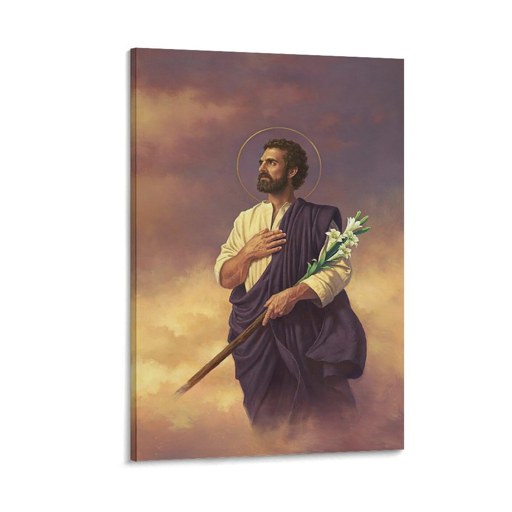
https://www.amazon.com/st-joseph-picture/s?k=st+joseph+picture
License: unknown
Joseph Hoàng Lương Cảnh
Saint- Life Span
- 1763 - 1838 (age 75)
- Feast Day
- 24 November
- Gender
- male
- Church
- Catholic
Places
Roles & Family
Religious Information
Canonization
Biography
Joseph Hoàng Lương Cảnh, known in Vietnamese as Giuse Hoàng Lương Cảnh, was a Vietnamese Catholic layman, traditional physician, and member of the Third Order of Saint Dominic, martyred in the nineteenth century during the anti-Christian persecutions of the Nguyễn dynasty. Catholic hagiographical sources give his year of birth as 1763 and identify his native place as the village of Văn (Làng Văn) in the Bắc Ninh region of Tonkin, in what is now northern Vietnam. He practiced oriental medicine as a village doctor, a calling that placed him among the local notables of a rural community and also gave him regular occasion to treat the sick, including the poor. He belonged to the large Catholic population that had grown up in East Tonkin under the pastoral care of Spanish Dominican missionaries, whose vicariate had been established in the region in the seventeenth and eighteenth centuries.
In that Dominican milieu Hoàng Lương Cảnh entered the Third Order of Saint Dominic, taking on the prayer, penance, and apostolic obligations of a lay tertiary while remaining in secular life rather than entering the priesthood or the convent. Traditional accounts present him as a man of steady piety and practical charity who used his medical skill in the service of his neighbors and who supported the often clandestine life of the Church by assisting priests and helping to sustain the faith in his locality. Lay tertiaries of this kind formed an important backbone of Tonkinese Catholicism: they were rooted in village society, yet bound by a rule to the Order of Preachers, and they frequently served as catechists, hosts, and protectors of missionaries when imperial policy turned hostile.
Hostility intensified under Emperor Minh Mạng (reigned 1820-1841), whose court treated Christianity as a heterodox and politically suspect foreign creed. Successive edicts forbade the faith, ordered missionaries expelled or put to death, and required suspected Christians to apostatize by trampling on a crucifix. In that climate Hoàng Lương Cảnh was arrested, imprisoned, and pressed to renounce Christianity. He refused. On 5 September 1838 he was executed by beheading at Sơn Tây, a fortified administrative center west of Hanoi. He was then an elderly man. The Church has remembered him among the lay witnesses of the Tonkinese missions who chose death rather than denial of Christ. Independent archival detail about his interrogation and about any family life is sparse; what survives comes chiefly from the acts and local memory gathered later for the beatification process.
His cause was advanced with those of other martyrs of the Dominican missions in Tonkin. He was beatified by Pope Leo XIII on 27 May 1900, in a large group of Vietnamese martyrs associated with those missions, and was canonized by Pope John Paul II on 19 June 1988, when 117 martyrs of Vietnam were raised to the altars together in Rome. In the General Roman Calendar their collective feast is kept on 24 November, under the title of Saint Andrew Dũng-Lạc and Companions. Joseph Hoàng Lương Cảnh is thus venerated as a saint of the Catholic Church, a lay Dominican and physician among the Vietnamese Martyrs. Much of the surviving portrait of his early life remains traditional rather than documentary, but the fact of his martyrdom at Sơn Tây in 1838, his identity as a Dominican tertiary and village doctor, and his place among the 117 canonized in 1988 are firmly established in the Church’s martyrology.