Joseph of Anchieta is a saint of the Catholic Church (1534 - 1597). Joseph of Anchieta's feast day is celebrated on 9 June. Joseph of Anchieta is the patron saint of Brazil;Canary Islands;catechists;students;people with scoliosis.
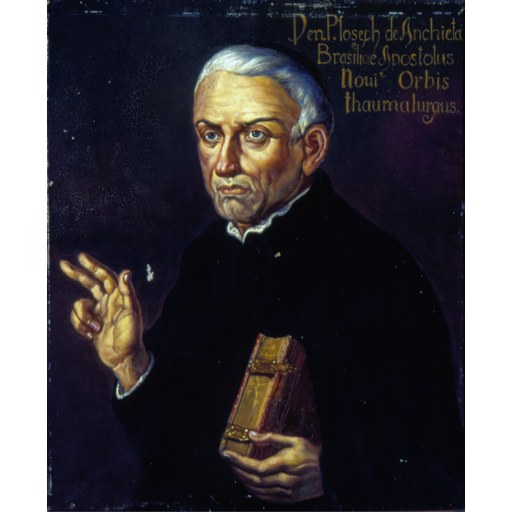
Oscar Pereira da Silva
License: Public domain
Joseph of Anchieta
Saint- Life Span
- 1534 - 1597 (age 63)
- Feast Day
- 9 June
- Gender
- male
- Church
- Catholic
Places
Relics & Where to Venerate
Location unknown
The bodily remains of Joseph of Anchieta are a first-class relic. Venerated at Colonial Brazil.
Roles & Family
Religious Information
Patronage
Brazil;Canary Islands;catechists;students;people with scoliosis
Canonization
Biography
Joseph of Anchieta, born José de Anchieta y Díaz de Clavijo on 19 March 1534 in San Cristóbal de La Laguna on Tenerife in the Canary Islands, was a Spanish Jesuit missionary, linguist, and writer who became one of the central figures of the sixteenth-century Catholic mission in Portuguese Brazil. His father, Juan de Anchieta, was a Basque landowner from Gipuzkoa with kinship ties to the family of Ignatius of Loyola; his mother, Mencía Díaz de Clavijo y Llarena, belonged to a Tenerife family of converso origin. Sent as a youth to study at the University of Coimbra in Portugal, he entered the Society of Jesus in 1551. Despite a spinal deformity that left him with a pronounced hunchback and lifelong pain, he volunteered for the overseas missions and sailed for Brazil in 1553, arriving at São Vicente while still a Jesuit scholastic not yet ordained.
In January 1554, together with Manuel da Nóbrega and a small company of Jesuits and indigenous converts, Anchieta helped establish the Colégio de São Paulo de Piratininga on the Piratininga plateau, an act traditionally regarded as the foundation of the city of São Paulo. He taught Latin there and rapidly acquired fluency in Tupi, the lingua franca of the coastal peoples. His Arte de gramática da língua mais usada na costa do Brasil, composed in the mid-sixteenth century and printed at Coimbra in 1595, was the first grammar of a native Brazilian language and remained a fundamental missionary instrument. He also produced catechisms, vocabularies, and a substantial body of religious drama—autos written in Portuguese, Spanish, Latin, and Tupi—that were staged to instruct both settlers and indigenous audiences in Christian doctrine.
In 1563 Anchieta and Nóbrega offered themselves as hostages to the Tamoio confederacy at Iperoig in order to negotiate an end to warfare that threatened the Portuguese coastal settlements. During months of captivity Anchieta composed, largely from memory and by tracing lines in the sand, a long Latin poem in honor of the Virgin Mary, De Beata Virgine Dei Matre Maria, of nearly five thousand hexameters. After his release he continued missionary circuits along the Brazilian coast, was ordained a priest in Bahia in 1566, and later served as rector of Jesuit colleges and as provincial of the Brazilian province of the Society of Jesus from 1577 to 1587. He spent his final years at the mission village of Reritiba in the captaincy of Espírito Santo, where he died on 9 June 1597.
Anchieta’s reputation for holiness, his role in the evangelization of Brazil, and his literary and linguistic legacy led to his being popularly styled the Apostle of Brazil. He was beatified by Pope John Paul II on 22 June 1980 and canonized by Pope Francis on 3 April 2014 through the procedure of equivalent canonization, which recognized a longstanding cultus. His feast is kept on 9 June. He is invoked as a patron of Brazil, of the Canary Islands, of catechists and students, and of those who suffer from spinal disorders.