Joseph of Arimathea is a saint of the Catholic Church. Joseph of Arimathea's feast day is celebrated on 31 August (Roman Martyrology); 31 July (Eastern Orthodox, Anglican, Lutheran); 17 March (some Western calendars). Joseph of Arimathea is the patron saint of funeral directors;undertakers;pallbearers;gravediggers;tin miners.
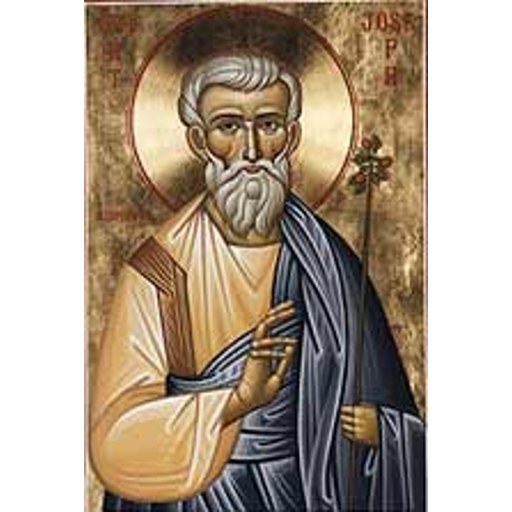
anonymous Original uploader was Guard at ru.wikipedia
License: Public domain
Joseph of Arimathea
Saint- Feast Day
- 31 August (Roman Martyrology); 31 July (Eastern Orthodox, Anglican, Lutheran); 17 March (some Western calendars)
- Gender
- male
- Church
- Catholic
Places
Relics & Where to Venerate
Housed at All Saints church · Czech Republic
On waking she found the dry staff had burst into leaf; it became an ash tree, the "greatest tree i All Saints Shrine at Sacred Heart Byzantine Catholic Church 29125 West Six Mile Road Livonia, MI 48152 Home | About | Timeline of Saints | List of Relics | Pilgrimages | Donate | Contact Saint Joseph of Arimathea The phalanges (finger bones) of the saint
Location unknown
On waking she found the dry staff had burst into leaf; it became an ash tree, the "greatest tree i All Saints Shrine at Sacred Heart Byzantine Catholic Church 29125 West Six Mile Road Livonia, MI 48152 Home | About | Timeline of Saints | List of Relics | Pilgrimages | Donate | Contact Saint Joseph of Arimathea The phalanges (finger bones) of the saint
Roles & Family
Patronage
funeral directors;undertakers;pallbearers;gravediggers;tin miners
Biography
Joseph of Arimathea is attested in all four canonical Gospels as a wealthy Jewish notable who obtained the body of Jesus of Nazareth from the Roman prefect Pontius Pilate and buried it in a rock-hewn tomb. The evangelists identify him with Arimathea, a town in Judea whose exact site is uncertain; proposed identifications have included Ramathaim-Zophim in the hill country of Ephraim and other locations in first-century Roman Judea. Matthew calls him a rich man and a disciple of Jesus. Mark and Luke present him as a respected member of the council, the Sanhedrin, who was waiting for the kingdom of God. Luke further describes him as good and righteous and states that he had not consented to the council's decision and action against Jesus. John records that he was a disciple of Jesus, but secretly, for fear of the Jewish authorities. These notices belong to the Passion narratives of the first century and are the only early evidence for his existence and deeds.
After the crucifixion, according to the Gospels, Joseph went to Pilate and asked for Jesus's body. Mark reports that Pilate was surprised that death had already occurred and confirmed it with the centurion before releasing the corpse. Joseph purchased linen cloth, took the body down from the cross, wrapped it, and laid it in a tomb cut from the rock, rolling a stone against the door. Matthew specifies that the tomb was Joseph's own new tomb, in which no one had yet been laid. John's Gospel adds that Nicodemus, who had previously come to Jesus by night, brought a mixture of myrrh and aloes and that the two men bound the body in linen cloths with the spices, according to Jewish burial custom. The tomb is located in a garden near the place of crucifixion. The canonical texts do not record Joseph's parentage, the year or place of his birth or death, whether he married or had children, or any activity after the burial.
Later Christian writings enlarged his role without supplying independently verifiable biography. The apocryphal Gospel of Nicodemus, also called the Acts of Pilate, which in surviving form is generally assigned to the fourth century or later, expands the interview with Pilate, describes Joseph's imprisonment by Jewish leaders, and narrates a miraculous deliverance. Other late-antique and early medieval homilies and apocrypha treat him as a witness to the burial and, in some traditions, to appearances after the resurrection. His personal name was common among Jews of the period; of Arimathea is a geographic designation rather than a family surname. No contemporary non-Christian source mentions him.
Medieval Western legend, especially from the twelfth century onward, attached Joseph to Britain. Writers connected with Glastonbury claimed that he had come as an apostle to the island, planted a staff that became the Glastonbury thorn, and established an early church there. Arthurian and Grail romances made him the guardian or conveyor of the Holy Grail. Folklore in Cornwall and Somerset associated him with the tin trade and, in later popular retellings, with a visit of the young Jesus to Britain. These narratives originated in the Middle Ages, find no support in the Gospels or in early patristic literature, and are not accepted as historical by modern scholars. They did influence local cult, pilgrimage, and patronage, including later invocation by tin miners.
Joseph of Arimathea has been venerated as a saint in both East and West from an early date, without a documented papal or conciliar act of canonization of the kind later used for medieval saints. The Roman Martyrology commemorates him on 31 August. The Eastern Orthodox Church keeps 31 July and also remembers him among the myrrh-bearers on the second Sunday after Pascha. Lutheran and Anglican calendars commonly observe 31 July; some Western uses have also kept 17 March. He is regarded as a patron of funeral directors, undertakers, pallbearers, and others who care for the dead. The year and place of his birth and death, his marital status, and the site of his own burial remain unknown.