Joseph of Cupertino is a saint of the Catholic Church (1603 - 1663). Joseph of Cupertino's feast day is celebrated on 18 September. Joseph of Cupertino is the patron saint of aviation;aviators;astronauts;air travelers;pilots;students;test taking;people with learning disabilities;Copertino;Osimo.
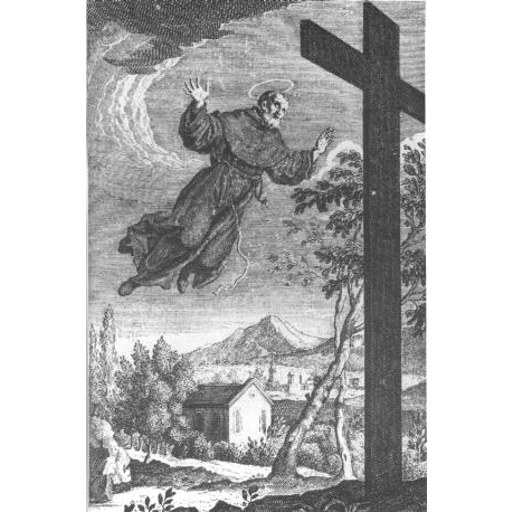
Unknown authorUnknown author
License: Public domain
Joseph of Cupertino
Saint- Life Span
- 1603 - 1663 (age 60)
- Feast Day
- 18 September
- Gender
- male
- Church
- Catholic
Places
Relics & Where to Venerate
Location unknown
The bodily remains of Joseph of Cupertino are a first-class relic. Venerated at Marche.
Roles & Family
Religious Information
Patronage
aviation;aviators;astronauts;air travelers;pilots;students;test taking;people with learning disabilities;Copertino;Osimo
Canonization
Biography
Joseph of Cupertino was born Giuseppe Maria Desa on 17 June 1603 in Copertino, a town in Apulia in the Kingdom of Naples. His father, Felice Desa, a carpenter, died before the child's birth, leaving the family destitute. Creditors seized the family home, and his mother, Francesca Panara, was forced to give birth in a stable. Joseph's childhood was marked by poverty, frail health, and what those around him regarded as unusual dullness and clumsiness. He received little schooling, stood often with his mouth open (which earned him the nickname Bocca Aperta), and was apprenticed without lasting success to a shoemaker. These early hardships and limitations later became central to the way he was remembered as a saint of the simple and the struggling.
After being refused by the Conventual Franciscans, he was accepted as a lay brother by the Capuchins around 1620, only to be dismissed within about a year because his awkwardness caused constant accidents in the community. He returned to Copertino and was eventually taken in by the Conventual Franciscans at the friary of Grottella as a servant in the stables. His piety impressed the friars, who allowed him to begin studies for the priesthood despite severe academic difficulties. He was ordained a priest in 1628. Traditional accounts hold that he passed the examination only because the examiner happened to question him on a Gospel passage he knew by heart. As a priest he remained poorly lettered, humble, and given to prayer, fasting, and care for the poor, living as a Conventual Franciscan rather than as a scholar or administrator.
From the 1630s he became widely known for frequent ecstasies and reported levitations, which witnesses said occurred during Mass, in prayer before the Blessed Sacrament, or at the mention of God or the Virgin Mary. These phenomena drew large crowds and provoked both devotion and official alarm. In 1638 the Inquisition of Naples investigated him; he was sent to Rome and thereafter confined for years in successive houses, including a long period at Assisi, in order to limit public access. Later transfers placed him with the Capuchins at Pietrarubbia and Fossombrone. In 1657 he was allowed to reside at the Conventual friary in Osimo in the Papal States, where he spent his last years in relative seclusion while continuing to experience raptures attested by members of his community. The reports of levitation were recorded by contemporaries of varying degrees of skepticism and remain the feature for which he is most famous.
Joseph died at Osimo on 18 September 1663. A cause for canonization followed in the next century: he was beatified by Pope Benedict XIV on 24 February 1753 and canonized by Pope Clement XIII on 16 July 1767. He is invoked as patron of aviators, astronauts, air travelers, students, and those taking examinations, as well as of people with learning disabilities, associations that reflect both the tradition of his levitations and his own struggles with study. His body is enshrined in the basilica dedicated to him in Osimo. He remains one of the best-known Franciscan mystics of the seventeenth century, and devotion to him has continued in Italy and among those who seek his intercession in travel, study, and intellectual difficulty.