Joseph the Hymnographer is a saint of the Catholic Church (d. 886). Joseph the Hymnographer's feast day is celebrated on 3 April.
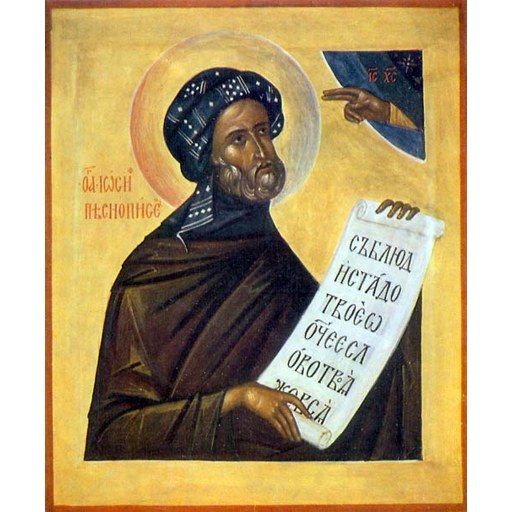
Russian unknown
License: Public domain
Joseph the Hymnographer
Saint- Life Span
- d. 886
- Feast Day
- 3 April
- Gender
- male
- Church
- Catholic
Places
Roles & Family
Biography
Joseph the Hymnographer was a Greek monk, priest, and liturgical poet of the ninth century, counted among the foremost hymnographers of the Eastern Orthodox Church. He was born in Sicily to Christian parents named Plotinus and Agatha. During the Arab conquest of the island, which began in the 820s, his family fled and found refuge in the Peloponnese. While still an adolescent he went to Thessalonica, entered a monastery, took the monastic habit, and was later ordained a priest. Near-contemporary accounts present him as marked already in youth by ascetic seriousness and a gift for sacred song. He is a Greek-speaking Sicilian of the Byzantine world, not a Western Latin author, and he should not be confused with Joseph of Thessalonica, the brother of Theodore the Studite, who was a different hymnographer of the same general era.
From Thessalonica he moved to Constantinople and became a disciple of Saint Gregory of Decapolis, whose community opposed the second period of imperial Iconoclasm. Gregory sent Joseph westward to Rome to report to the pope on the condition of the Church under the iconoclast emperor. On the journey Joseph was seized by Arab corsairs and carried to Crete, then under Muslim rule, where he was held in bondage for several years. Hagiographical tradition states that he strengthened Christian captives in the faith and that Saint Nicholas appeared to him to announce his coming freedom. After his release he returned to the capital and found that Gregory had died. Joseph then founded a monastery of his own in Constantinople, associated in the sources with the church of Saint John Chrysostom, gathered his master's relics, and settled into monastic governance and liturgical composition.
The middle decades of the ninth century in Constantinople were dominated by the struggle between Patriarch Ignatius and Patriarch Photius. Joseph took the part of Ignatius and was sent into exile; he was later recalled. Photius, during a subsequent tenure, appointed him skeuophylax of the Great Church of Hagia Sophia, that is, custodian of the sacred vessels, an office of high standing. He was never bishop, patriarch, or pope. In these years and until the end of his life he produced an enormous body of liturgical poetry. He is credited with more than two hundred canons, together with stichera and other hymns, many of which were received into the Menaion, the Parakletike, and other Byzantine service books. His verse supplied offices for numerous saints who had previously lacked proper canons and helped shape weekday and festal worship in the Byzantine rite. Later tradition often ranks him after John of Damascus and Cosmas of Maiuma among Greek ecclesiastical poets.
Joseph died in Constantinople, according to the prevailing tradition, in 886, commonly given as 3 April, and was buried at the monastery he had established in the capital. The Eastern Orthodox Church keeps his feast on 3 April; he also appears in Western martyrologies. Surviving knowledge of his life depends chiefly on hagiographical vitae written after his death, so that his exact year of birth, some episodes of the captivity narrative, and a few chronological details remain approximate rather than precisely documented. His reputation rests on the large corpus of hymns still used in Orthodox worship and on the memory of a monk who confessed the veneration of icons, endured captivity and exile, and devoted his learning to the liturgical praise of God and the saints.