Józef Stanek is a blessed of the Catholic Church (1916 - 1944). Józef Stanek's feast day is celebrated on 12 June.
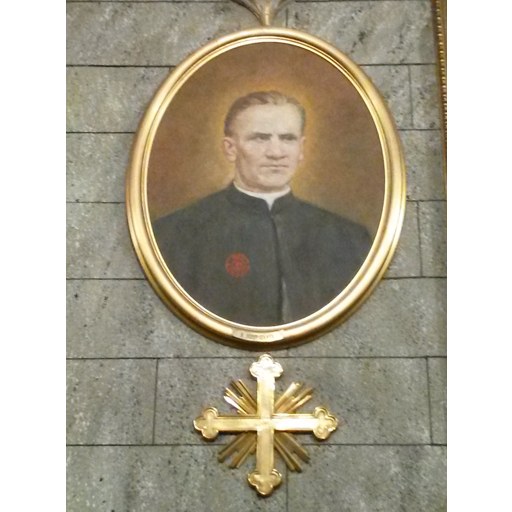
Fraychero
License: CC BY-SA 4.0
Józef Stanek
Blessed- Life Span
- 1916 - 1944 (age 28)
- Feast Day
- 12 June
- Gender
- male
- Church
- Catholic
Places
Roles & Family
Religious Information
Canonization
Biography
Józef Stanek was born on 4 December 1916 in the village of Łapsze Niżne in the Spisz region, then belonging to Austria-Hungary and inhabited by a Polish Catholic population. He was raised in a devout family and entered the Society of the Catholic Apostolate, the congregation founded by Saint Vincent Pallotti and commonly known as the Pallottines. His formation as a religious and seminarian took place in the late 1930s, as Europe moved toward war. He was ordained a priest in 1941, during the German occupation of Poland, when the Catholic clergy were already under severe persecution as bearers of Polish religious and national life.
As a young Pallottine, Stanek exercised his ministry chiefly in Warsaw under occupation. Public pastoral work was restricted, seminaries and many churches were watched or closed, and priests were frequently arrested. Like other clergy who remained at their posts, he provided the sacraments, instruction, and spiritual care in conditions of secrecy and danger. The occupation authorities regarded the Polish Church as an obstacle to their rule, and hundreds of priests were imprisoned or killed; Stanek’s ministry belonged to that same threatened world of wartime Polish Catholicism.
When the Warsaw Uprising began in August 1944, Father Stanek served as a chaplain to Home Army insurgents, especially in the Czerniaków district along the Vistula. He stayed with combatants and civilians, celebrating Mass in ruined buildings, hearing confessions, anointing the dying, and assisting the wounded in improvised hospitals under bombardment. As German forces recaptured the district in September, he did not withdraw with retreating units but remained with those who could not leave. He was taken prisoner and hanged on 23 September 1944 in Warsaw. He was twenty-seven. Witness accounts long current in Polish Catholic memory state that his executioners used his priestly stole as the noose, an act meant to degrade his office as well as to kill him.
After the war he was remembered as a martyr of the uprising and of the occupation. On 13 June 1999 Pope John Paul II beatified him in Warsaw together with 107 other Polish victims of the Second World War, the group known as the 108 Martyrs of World War II. They are commemorated on 12 June. Stanek’s cult rests on his youth, his religious vows, his choice to stay with the wounded, and his death at the hands of the occupying power. He has not been canonized. Surviving detail about his childhood, exact sequence of assignments, and the precise site of burial remains limited in publicly established sources, and later hagiography should not be confused with fully documented biography.