Jožefa Antonija Fabjan is a blessed of the Catholic Church (d. 1941). Jožefa Antonija Fabjan's feast day is celebrated on 15 December.
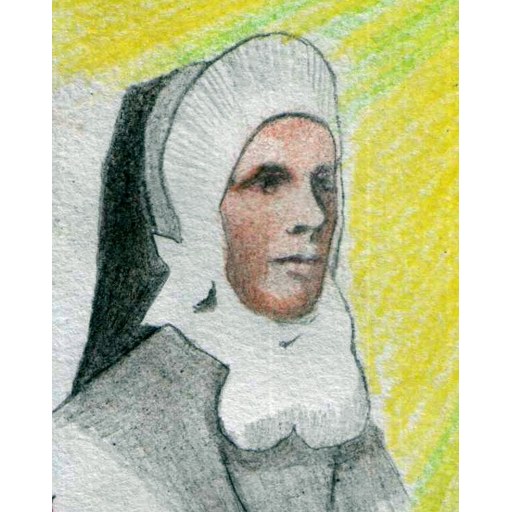
István Tápai
License: Public domain
Jožefa Antonija Fabjan
Blessed- Life Span
- d. 1941
- Feast Day
- 15 December
- Gender
- female
- Church
- Catholic
Places
Roles & Family
Religious Information
Canonization
Biography
Jožefa Antonija Fabjan, known in religion as Sister Antonija, was a Slovenian member of the Congregation of the Daughters of Divine Charity and is honoured by the Catholic Church as one of the five Blessed Martyrs of Drina. She was born in Malo Polje, a village in the Dolenjska (Lower Carniola) region of present-day Slovenia, then part of the Austro-Hungarian Empire, in the first decade of the twentieth century. After entering the congregation founded in Vienna by Franziska Lechner, she received the religious name Antonija. The Daughters of Divine Charity devoted themselves to the education of girls, care of the poor, and other works of mercy; Fabjan was eventually assigned to the sisters’ house at Pale, east of Sarajevo in Bosnia, a region of mixed Catholic, Orthodox, and Muslim population where the community maintained a school and charitable works.
The collapse of the Kingdom of Yugoslavia in 1941 left eastern Bosnia a contested zone, claimed by the Independent State of Croatia yet crossed by Chetnik detachments and other armed groups. In December 1941 Chetnik forces occupied Pale. The five sisters of the local community—Jula Ivanišević, Berchmana Leidenix, Krizina Bojanc, Antonija Fabjan, and Bernadeta Banja—left the convent in an attempt to reach safety. They were captured and taken toward Goražde on the river Drina. According to testimonies later examined in the beatification process, the four younger sisters, including Antonija, were confined in a building in Goražde and threatened with sexual violence. During the night of 15 December 1941 they fell or were thrown from an upper storey; their bodies were consigned to the Drina. The elderly Sister Berchmana, separated earlier because of infirmity, died later the same month. The Church came to regard their deaths as martyrdom in defence of consecrated chastity and in a context of wartime hostility toward Catholic religious.
From the later 1940s the five nuns were remembered among Croatian and Slovenian Catholics, and in the Church in Bosnia, as the Martyrs of Drina. A cause of beatification was introduced; the diocesan inquiry collected surviving depositions, and the Congregation for the Causes of Saints recognized the deaths as martyrdom. On 24 September 2011 they were beatified at a Mass in Sarajevo celebrated by Cardinal Angelo Amato, prefect of that Congregation, acting as legate of Pope Benedict XVI. They have not been canonized. Their joint liturgical memorial is kept on 15 December. No distinct individual patronages are securely documented for Sister Antonija apart from her share in the group’s cult.
Personal documentation of Fabjan’s life is sparse. She left no known spiritual writings, and wartime destruction and displacement erased much of the Pale convent’s archive. She is therefore known chiefly through the collective narrative of her community and through the acts of the beatification process: a relatively young religious who remained with her sisters under threat and who, in the judgment of the Church, died a martyr beside the Drina. Her memory belongs to the larger history of civilian and religious victims in Bosnia in 1941, a history in which Catholic, Orthodox, and Muslim communities all suffered and in which the fragmentary evidence must be handled with caution.