Julian is a saint of the Catholic Church.
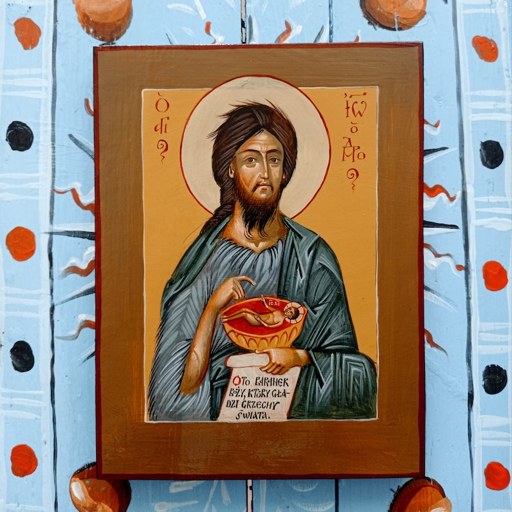
https://www.etsy.com/uk/listing/1518487637/saint-john-the-baptist-picture-icon
License: unknown
Julian
Saint- Church
- Catholic
Biography
The single given name Julian (Latin Iulianus; Greek Ioulianos) is shared by many figures in Christian hagiography and church history. The request supplies no Wikidata identifier, no encyclopedia article, and no distinguishing date, see, or place. A careful historian therefore cannot treat “Julian” as one recoverable person, and must not invent a birth year, death year, city, spouse, order, or patronage list by borrowing details from several different lives. The structured fields above are left blank for that reason. What follows is not a composite biography but a cautious survey of the principal holy and ecclesiastical Julians, so that the limits of the evidence remain clear.
In the Latin West, one of the better-documented bearers of the name is Julian of Toledo, archbishop of the Visigothic capital in the later seventh century. He is associated with Toledo in the Iberian Peninsula and died in 690; a birth year is not securely attested in contemporary records, though modern handbooks often place his birth in the middle of that century. He wrote theological and pastoral works, among them the Prognosticum futuri saeculi, and took part in the councils and doctrinal disputes of the Visigothic church. He is venerated as a saint in the Roman calendar, commonly on 8 March. He was neither Bishop of Rome nor an Eastern patriarch, and claims about his family origin, while often repeated, rest on later tradition rather than on a full contemporary dossier.
A far more popular but historically elusive figure is Julian the Hospitaller, whose legend was widely circulated in the later Middle Ages, especially through the Golden Legend. In that story a man named Julian, after a tragic killing of his parents, spent the rest of his life ferrying and lodging travelers and the poor. The narrative is not anchored to a verified century of birth or death and is attached, in conflicting local traditions, to more than one region of France and the Low Countries. Modern scholarship treats the Hospitaller as pious legend rather than as a biography that can be dated. Despite that, he became a familiar patron of innkeepers, travelers, and boatmen; Western feast days associated with him vary by diocese and often fall in January or February (12 February is frequently cited). No burial place or canonizing pope can be named from primary evidence.
The Greek East commemorates Julian of Anazarbus (also called Julian of Antioch or of Tarsus), a martyr of the Diocletianic persecution in Cilicia. His death is placed in the early fourth century. According to the passio he endured prolonged tortures and was finally drowned, in some versions in a sack with serpents. The cult is ancient in the Eastern calendars; feast days include 16 March in many Byzantine uses and, in some Latin martyrologies, a date in June. Birth year, parents, spouse, and a historically verified tomb are not known from documents of his own time. Separate from him are still other Eastern ascetics such as Julian Sabas, a fourth-century hermit of the Syrian-Mesopotamian world, whose life belongs to the literature of early monasticism rather than to the Roman episcopal lists.
Further Julians cannot be merged with any of the above. Julian of Le Mans is traditionally counted as an early bishop of that Gallic see, with a feast on 27 January; the dates of his mission are disputed and partly legendary. In late medieval England the anchoress known as Julian of Norwich (active in the late fourteenth and early fifteenth centuries) wrote the Revelations of Divine Love; she was a woman, her baptismal name may not have been Julian, and she has not been the object of a universal papal canonization, though she is commemorated in some Anglican and Catholic local calendars (often in May). None of these persons was Pope of Rome or Coptic Pope of Alexandria in any standard list. Because the subject of this record is only the undifferentiated name “Julian,” no single year of birth, marriage, religious order, feast day, or canonizing authority can be verified, and it would be unsound to fill those fields by guesswork.