Julian is a saint of the Catholic Church.
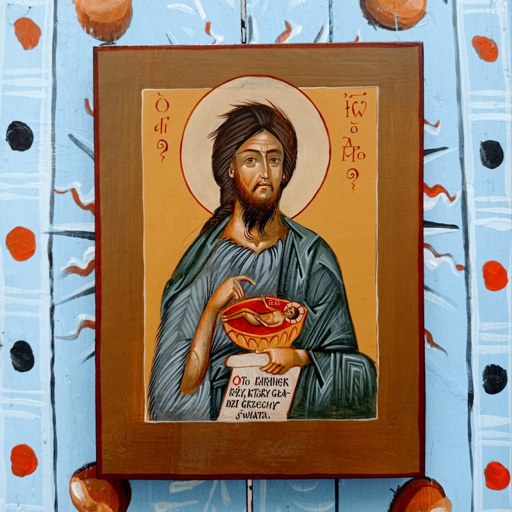
https://www.etsy.com/uk/listing/1518487637/saint-john-the-baptist-picture-icon
License: unknown
Julian
Saint- Church
- Catholic
Biography
The single given name Julian, without a Wikidata identifier, a Wikipedia article, a see, a feast date, or an epithet, does not identify one historical person. Iulianus was a common Roman cognomen and later a frequent baptismal name; Christian sources therefore record many distinct Julians—martyrs, bishops, ascetics, a Pelagian theologian, a Roman emperor, and an English anchoress—whose lives cannot be merged. Reliable method forbids filling birth year, death year, places, gender, order, marriage, children, papal or patriarchal office, feast day, patronages, or canonization data by guessing the best-known namesake or by substituting an office-taking year for a birth year. All structured fields are therefore left empty.
Among Latin hagiographical namesakes, the most widely told story is that of Julian the Hospitaller, a legendary nobleman who, in the form popularized from the thirteenth century (notably in the Golden Legend), accidentally killed his parents and thereafter kept a hospice and ferry for travelers. That narrative is a pious romance, not a recoverable biography of a dated individual. Separate from it are Julian of Le Mans, a semi-legendary first bishop of that city sometimes placed in the third or fourth century, and Julian of Toledo, who died in 690 as archbishop of Toledo and a major theologian of Visigothic Spain. These are different people; treating any one of them as “the” Julian of an unspecified query would be an error.
Eastern and North African calendars and histories add further distinct figures: Julian of Antioch (also associated with Anazarbus), a martyr under the Diocletianic persecution whose cult is ancient; Julian Sabas, a fourth-century Syrian ascetic; and other Julians listed in the synaxaria. Julian of Eclanum (active in the early fifth century) was a married Italian bishop and a leading Pelagian controversialist, not a saint in the Catholic or Orthodox calendars. The emperor Flavius Claudius Julianus, known as Julian the Apostate (born 331, died 363), was a pagan restorer, not a Christian saint. Julian of Norwich (born in the fourteenth century, died after 1416) was an English woman, an anchoress and mystic, despite the masculine form of the name. None of these lives can be assumed to be the subject.
Because the query supplies no further identifier, a cautious notice stops here. Century, region, and office can be stated only for a named, sourced individual; they cannot be invented or borrowed from the most famous Julian in order to complete a form.