Julian is a saint of the Catholic Church.
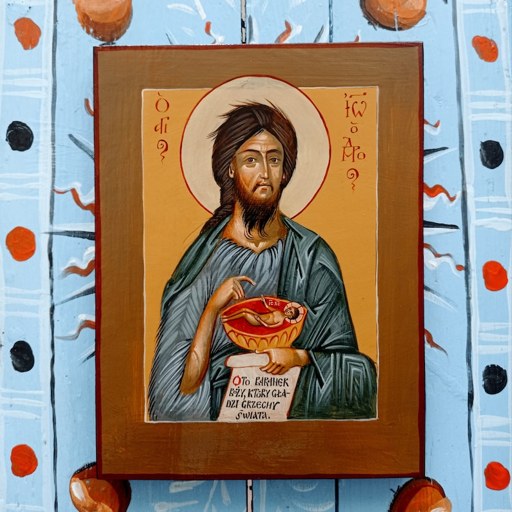
https://www.etsy.com/uk/listing/1518487637/saint-john-the-baptist-picture-icon
License: unknown
Julian
Saint- Church
- Catholic
Biography
The single given name Julian (Latin Julianus; related forms include Julien, Julián, and Giuliano) cannot be matched to one verified historical person. Christian martyrologies, episcopal lists, and later calendars contain many distinct Julians—Roman-era martyrs, early bishops in Gaul and Spain, a legendary hospitaller, a Visigothic archbishop, a Pelagian controversialist, and the English anchoress commonly called Julian of Norwich. Without a toponym, feast date, century, or other disambiguator, no birth year, death year, birthplace, burial site, or unique patronage list can be assigned without conflating separate lives. The fields above are therefore left blank.
In the Latin West the most widely diffused cult is that of Julian the Hospitaller, a largely legendary figure whose medieval vitae describe a nobleman who, after an accidental killing of his parents, did penance by ferrying travelers and lodging the poor. The story circulated in France and Italy from the high Middle Ages; he became associated with innkeepers, travelers, and boatmen. The narrative is hagiographical romance rather than documented biography: no historically attested birth or death year survives, and places of origin and burial vary by local tradition. Another frequently cited martyr is Julian of Antioch (also linked with Anazarbus in Cilicia), placed by later sources in the late third or early fourth century; relics and a cult at Antioch are reported, but precise dates and a verified birthplace are not securely established. Julian of Le Mans appears in Frankish tradition as an early bishop of that see; modern historians treat the earliest layers of his legend with caution and do not accept a first-century apostolic dating as fact.
A different Julian is Julian of Toledo, who died in 690 and served as archbishop of Toledo in Visigothic Spain; he is a documented churchman and writer, not a pope or an Eastern patriarch, and should not be merged with the legendary hospitaller. Julian of Eclanum (often dated to the late fourth and mid-fifth centuries) was a bishop in southern Italy associated with the Pelagian controversy; he is a historical theologian, not a canonized cult figure in the same sense as the martyrs. In England, the woman known as Julian of Norwich (active in the late fourteenth and early fifteenth centuries) was an anchoress beside the church of St Julian in Norwich and author of the Revelations of Divine Love; “Julian” is generally taken from the church’s dedication, and her baptismal name is unknown. She lived as a recluse, is not recorded as married or as a mother, and was neither pope nor patriarch. Using her for a record labeled only “Julian” would be misleading.
Eastern calendars likewise list multiple martyrs and monks named Julian, including figures associated with Egypt, Syria, and Asia Minor, often with little more than a feast commemoration and a brief passion narrative. Feast days attached to the name therefore differ by church and by which Julian is intended (among them dates in January, February, June, August, and September in various uses). Patronages similarly belong to specific cults—travelers and innkeepers to the Hospitaller legend, particular towns or dioceses to local bishops—and cannot be pooled into one list. No Bishop of Rome and no Coptic pope bore the name Julian (Julius is a different name); whether any given Julian held an Eastern patriarchal or catholicosal see depends entirely on which person is meant and is not verifiable from the name alone.
Because these individuals differ in gender, century, region, office, and degree of historicity, a single verified biography does not exist for the undifferentiated subject “Julian.” Anyone seeking a particular saint or historical Julian should supply a place-name, a feast day, a religious order, or a century so that the record can be filled from identifiable sources rather than by conjecture.