Julian of Norwich is a blessed of the Catholic Church. Julian of Norwich's feast day is celebrated on 8 May.
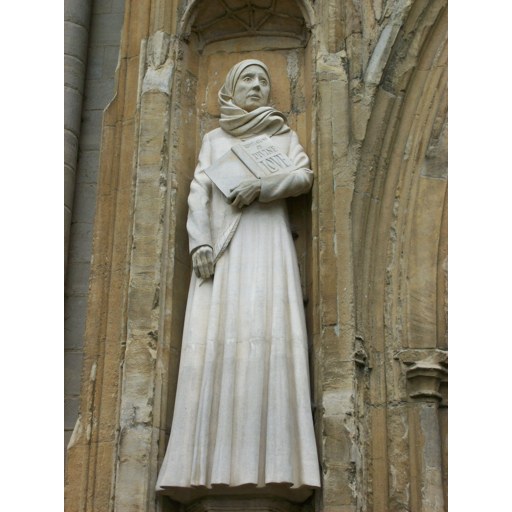
Poliphilo
License: CC0
Julian of Norwich
Blessed- Feast Day
- 8 May
- Gender
- female
- Church
- Catholic
Places
Roles & Family
Biography
Julian of Norwich was an English Christian mystic and anchoress of the late fourteenth and early fifteenth centuries, and the author of Revelations of Divine Love, also known as the Showings. Almost nothing can be established about her family, education, or early life from independent records. Even her personal name is unknown: the designation Julian is generally taken to come from the Church of St Julian in Conesford, Norwich, to which her anchorhold was attached, rather than from a baptismal name. She is sometimes styled Dame Julian or Mother Julian in later tradition. Norwich in her lifetime was one of the largest and most prosperous cities in the Kingdom of England, with a dense landscape of parish churches, religious houses, and hospitals, and it suffered recurrent visitations of plague in the decades after 1348.
In May 1373, when she was thirty and a half years old, she fell so gravely ill that she and those attending her expected her death. A curate was called to administer the last rites, and a crucifix was held before her eyes. In that state she received a sequence of sixteen visions, or showings, centred on the Passion of Christ and on the nature of God's love. She recovered, and over the following decades she composed two accounts of the experience. A short text is usually dated not long after the visions; a much longer text, the product of some twenty years of meditation, expands the original showings with theological reflection. In the longer version she records the divine assurance, given in the thirteenth showing, that "all shall be well, and all shall be well, and all manner of thing shall be well." The work is written in Middle English and is the earliest surviving book in English known to have been written by a woman.
By the 1390s she was living as an anchoress in a cell attached to St Julian's Church in Norwich. Anchoresses were solemnly enclosed for life, sharing in the church's liturgy through a window into the sanctuary and speaking with visitors, including those who sought spiritual advice, at a window that opened onto the world. Several Norwich-area wills from the early fifteenth century leave small bequests to her. Around 1413 the mystic Margery Kempe visited her and later recorded that Dame Jelyan gave her counsel and comfort. In 1416 Isabel Ufford, Countess of Suffolk, left twenty shillings to Julian, recluse at Norwich, which is the last firmly dated evidence that she was still alive. The date of her death is unknown, as is her place of burial; she is presumed to have died at Norwich sometime after 1416. Whether she had earlier been a nun, perhaps at the Benedictine house of Carrow Abbey nearby, a secular laywoman, or a widow has never been demonstrated, and modern historians treat those suggestions as speculative.
Her theology is marked by an emphasis on the tenderness and courtesy of God, by the image of Christ as mother, and by a refusal to resolve the problem of sin and damnation in a way that would limit divine love. She distinguishes between God as father and God as mother without abandoning orthodox Trinitarian language, and she presents sin as a necessary wound that is finally taken up into mercy. She does not appear to have been formally beatified or canonized by the Roman Catholic Church. She is nonetheless widely venerated. The Church of England, the Episcopal Church, and several Lutheran churches commemorate her on 8 May. Interest in her writings remained limited until the seventeenth century, when English Benedictine nuns on the Continent preserved and copied the long text; she became a major figure in English spirituality only in the twentieth century, after critical editions and modern translations made the Revelations widely available.