Juliana of Liège is a saint of the Catholic Church (1193 - 1258). Juliana of Liège's feast day is celebrated on 6 April.
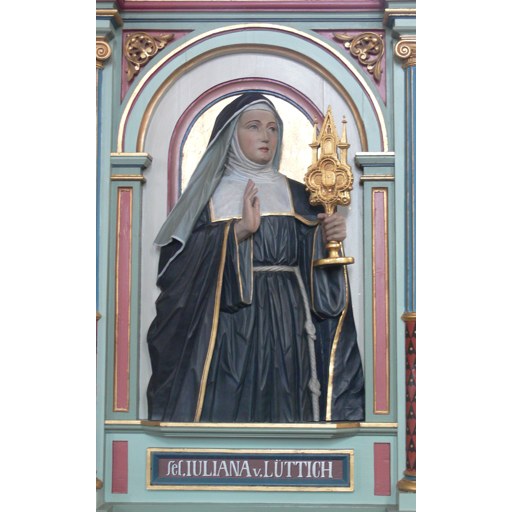
Photo: Andreas Praefcke
License: CC BY 3.0
Juliana of Liège
Saint- Life Span
- 1193 - 1258 (age 65)
- Feast Day
- 6 April
- Gender
- female
- Church
- Catholic
Places
Relics & Where to Venerate
Location unknown
The bodily remains of Juliana of Liège are a first-class relic. Venerated at Villers Abbey.
Roles & Family
Religious Information
Canonization
Biography
Juliana of Liège, also known as Juliana of Mount Cornillon, was a thirteenth-century mystic and Augustinian canoness whose visions and persistence were decisive in the origin of the Feast of Corpus Christi. She was born at Retinne, near Liège, in the Prince-Bishopric of Liège, in 1193. Orphaned at about the age of five, she and her sister Agnes were placed in the convent of Mont-Cornillon, a house of canons and canonesses regular following the Rule of Saint Augustine and attached to a hospital for lepers outside the city. There she received an unusually thorough education for a woman of her time: she learned Latin and read Scripture and the Church Fathers, especially Saint Augustine. She made her religious profession at Mont-Cornillon and in due course became prioress of the women’s community.
From about her sixteenth year she experienced repeated mystical visions. The best known presented the Church under the figure of a full moon marked by a dark band or spot, which she came to interpret as the absence of a liturgical feast dedicated specifically to the Blessed Sacrament. For years she kept the matter private, then confided it to her friend Eve of Saint-Martin, an anchoress at Liège, and to clergy who could act on it. With the help of John of Lausanne, a canon of Saint-Martin, a proper office for such a feast was prepared. In 1246 Bishop Robert of Thourotte instituted the solemnity of Corpus Christi in the diocese of Liège, the first episcopal establishment of the feast. The Dominican Hugh of Saint-Cher, later cardinal and papal legate, likewise promoted it in the region.
Her later life was overshadowed by conflict. Disputes over the temporal administration of Mont-Cornillon, together with hostility to her spiritual claims and to reform, led to her expulsion from her own convent. She took refuge at various houses, including the Cistercian convent of Salzinnes near Namur, but local politics and further opposition forced her to move repeatedly. She spent her last years at Fosses-la-Ville and died there on 5 April 1258. In accordance with her wish she was buried at the Cistercian abbey of Villers in Brabant.
She did not live to see the feast adopted by the universal Church. That step was taken by Jacques Pantaléon, formerly archdeacon of Liège, who as Pope Urban IV extended Corpus Christi to the Latin Church in 1264 and commissioned Thomas Aquinas to compose the liturgical office long associated with the solemnity. Juliana’s cult remained largely local until Pope Pius IX confirmed it for the whole Church in 1869. She is commemorated on 6 April and is remembered above all as the principal medieval advocate of a feast in honour of the Eucharist.