Julius Nyerere is a servant of god of the Catholic Church (1922 - 1999).
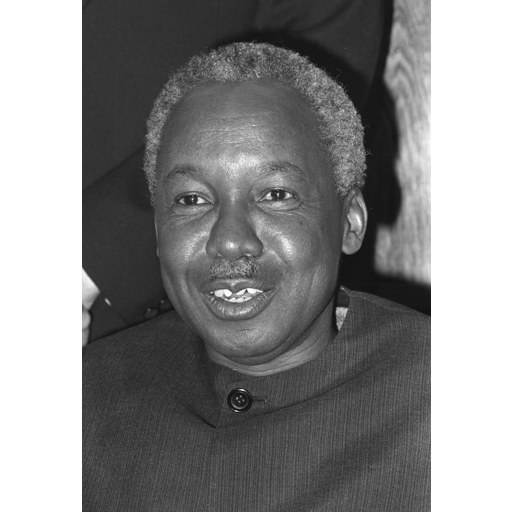
Rob Mieremet / Anefo
License: CC0
Julius Nyerere
Servant of God- Life Span
- 1922 - 1999 (age 77)
- Gender
- male
- Church
- Catholic
Places
Relics & Where to Venerate
Location unknown
The bodily remains of Julius Nyerere are a first-class relic. Venerated at Mara Region.
Roles & Family
Religious Information
Biography
Julius Kambarage Nyerere was born in 1922 in the village of Butiama, near the eastern shore of Lake Victoria in what was then Tanganyika Territory, a British-administered mandate. He was a son of Nyerere Burito, a traditional chief of the Zanaki people, and of Mugaya Nyang'ombe. Raised in a rural chiefly household, he received early schooling at local mission and government schools before attending Tabora Government School. In the 1940s he studied at Makerere College in Uganda, where he trained as a teacher. During those years he was baptized into the Roman Catholic Church and took the Christian name Julius. After teaching in Tanganyika he won a scholarship to the University of Edinburgh, completing a Master of Arts degree in the early 1950s and becoming one of the first Tanganyikans to graduate from a British university. His time in Scotland exposed him to Fabian socialist ideas and to debates on colonial rule and African self-government.
Returning home, Nyerere taught at St. Francis' College at Pugu and entered nationalist politics. In 1953 he married Maria Gabriel Magige, a fellow Catholic; they had several children. The following year he became president of the newly formed Tanganyika African National Union (TANU), which he led as a mass, non-racial independence movement. Tanganyika achieved independence in 1961 with Nyerere as prime minister; he became president of the republic in 1962. After the union of Tanganyika and Zanzibar in 1964 he served as the first president of the United Republic of Tanzania, remaining in office until 1985. He was widely known by the Swahili honorific Mwalimu, meaning teacher, a title that reflected both his original profession and his self-understanding as a moral and political educator of the nation.
As head of state Nyerere articulated the ideology of ujamaa, or familyhood, set out most fully in the Arusha Declaration of 1967. He sought a form of African socialism based on communal village life, nationalization of major enterprises, and one-party democracy under TANU (later Chama Cha Mapinduzi). The villagization campaigns of the 1970s relocated large numbers of rural people, with mixed and often harsh economic and social results; Tanzania remained poor and became heavily dependent on foreign aid. In foreign policy he was a leading figure in the Non-Aligned Movement, a supporter of liberation struggles in southern Africa, and a host to exiled movements. In 1978–1979 Tanzanian forces intervened in Uganda and contributed to the overthrow of Idi Amin. Nyerere left the presidency in 1985, an uncommon voluntary departure among his generation of African leaders, and was succeeded by Ali Hassan Mwinyi. He remained chairman of the ruling party for a time and later acted as a mediator in regional conflicts, including in Burundi.
Nyerere’s Catholic faith was a consistent thread in his private life. He attended Mass regularly, translated parts of Scripture and the liturgy into Swahili, and was known for a personal austerity that admirers linked to Christian and traditional African ethics. After his death in London in 1999, following treatment for leukemia, his body was returned to Tanzania for a state funeral and burial at Butiama. In 2005 the Catholic Diocese of Musoma opened a cause for his beatification, and he was declared a Servant of God. The cause has emphasized his integrity, concern for the poor, and witness as a lay Catholic in public life. He has not been beatified or canonized, and he holds no official feast day or patronages in the Church’s calendar. Historians continue to debate the successes and failures of ujamaa, but his role in leading Tanganyika to independence and in shaping postcolonial Tanzania is not in dispute.