Jurgis Matulaitis-Matulevičius is a blessed of the Catholic Church (1871 - 1927). Jurgis Matulaitis-Matulevičius's feast day is celebrated on 27 January.
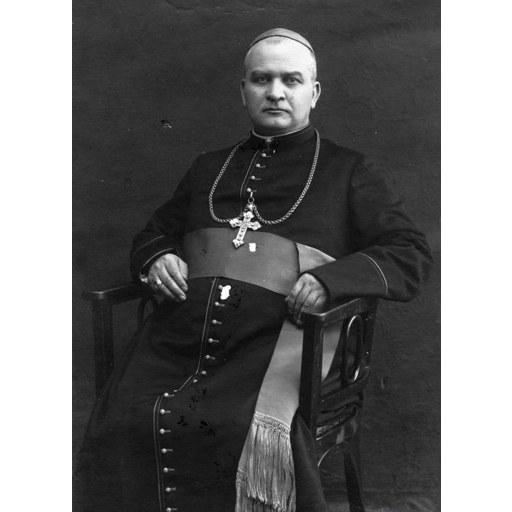
Unknown authorUnknown author
License: Public domain
Jurgis Matulaitis-Matulevičius
Blessed- Life Span
- 1871 - 1927 (age 56)
- Feast Day
- 27 January
- Gender
- male
- Church
- Catholic
Places
Relics & Where to Venerate
Location unknown
The bodily remains of Jurgis Matulaitis-Matulevičius are a first-class relic. Venerated at Church of St. Michael the Archangel, Marijampolė.
Roles & Family
Religious Information
Canonization
Biography
Jurgis Matulaitis-Matulevičius was born on 13 April 1871 in the village of Lūginė near Marijampolė, in the Suwałki Governorate of Congress Poland, then part of the Russian Empire. He belonged to a Lithuanian-speaking peasant family and was among the younger of several siblings. His father died when he was a small child and his mother a few years later, so that he grew up under the care of an older brother. Throughout his life he suffered from the effects of bone tuberculosis contracted in youth, which left him with a permanent limp and recurring illness. After attending the gymnasium in Marijampolė he entered the diocesan seminary at Kielce in the early 1890s. Political and cultural tensions surrounding Lithuanian national activity led to transfers, and he completed philosophical and theological studies in Warsaw and at the Imperial Roman Catholic Theological Academy in Saint Petersburg. He was ordained a priest in 1898 and soon afterward pursued higher studies at the University of Fribourg in Switzerland, where he obtained a doctorate in theology in 1902.
In the years that followed he taught at the Saint Petersburg Theological Academy and undertook pastoral work in Warsaw, where he became known for efforts among industrial workers and for promoting Catholic social action in an environment of rapid urbanization and socialist agitation. In 1909, at a time when Tsarist law had reduced Latin-rite religious orders in the empire almost to extinction, he secretly made his profession in the Congregation of Marian Fathers of the Immaculate Conception, joining the last surviving member of that community. Elected superior general, he obtained from the Holy See a thorough revision of the Marian constitutions, opened the congregation to men of different nations, and founded or restored houses in Poland, Lithuania, Switzerland, and the United States. His leadership turned a dying community into an international religious family dedicated to education, parish work, and the spreading of devotion to the Immaculate Conception.
Pope Benedict XV appointed him Bishop of Vilnius in 1918, and he was consecrated in December of that year. The diocese covered a region claimed by both the newly restored Polish and Lithuanian states and inhabited by Poles, Lithuanians, Belarusians, Jews, and others. During his episcopate the city passed through German withdrawal, Bolshevik occupation, and Polish control, while nationalist parties on all sides demanded that the bishop take their part. Matulaitis attempted to act as a pastor above national factions, visiting parishes, defending the rights of the Church, and relieving wartime poverty; the attempt earned him distrust from Lithuanian and Polish nationalists alike. He resigned the see in 1925. Pope Pius XI then named him titular Archbishop of Adulis and Apostolic Visitator to Lithuania. In that office he worked to regularize church structures in the independent Lithuanian republic, contributing to the erection of an ecclesiastical province with Kaunas as the metropolitan see.
Matulaitis died in Kaunas on 27 January 1927 after an attack of appendicitis. He was first interred in Kaunas; in 1934 his remains were transferred to the Church of St. Michael the Archangel in Marijampolė, the historic center of the Marian congregation in Lithuania. Pope John Paul II beatified him in Rome on 28 June 1987. He is venerated especially by the Marian Fathers and in Lithuania as a model of religious renewal, episcopal prudence in times of national conflict, and concern for the poor and for the proper organization of church life.