Justa and Rufina is a saint of the Catholic Church (d. 287). Justa and Rufina's feast day is celebrated on 19 July. Justa and Rufina is the patron saint of Seville;potters;ceramists.
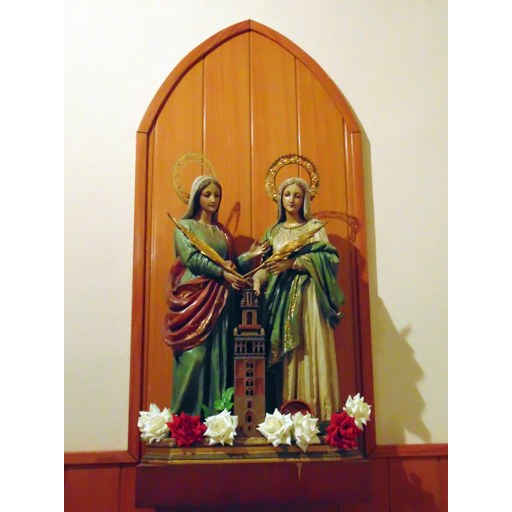
Josep Maria Viñolas Esteva
License: CC BY 2.0
Justa and Rufina
Saint- Life Span
- d. 287
- Feast Day
- 19 July
- Gender
- female
- Church
- Catholic
Places
Roles & Family
Patronage
Seville;potters;ceramists
Biography
Justa and Rufina were two Christian sisters of the third century, associated from the earliest local tradition with Hispalis, the Roman city that became Seville, in the province of Hispania Baetica. No contemporary document records their years of birth, parentage, or exact social standing; later hagiography describes them as members of a poor or modest Christian household who supported themselves by making and selling pottery. They are commemorated as laywomen and virgin martyrs, not as members of a religious order, and there is no historical indication that either married or had children. Their names and cult are firmly rooted in Seville: they appear in the Mozarabic liturgy and were already known to Isidore of Seville in the early seventh century, which indicates that veneration of the pair was established in the city well before the medieval elaboration of their legend.
The traditional account of their passion, preserved in a Latin passio of uncertain date and regarded by modern historians as largely legendary in its narrative detail, places their arrest and death in the later third century, most often in the year 287, during the reign of the emperor Diocletian. According to this story they refused to sell their earthenware for use in pagan rites, in particular a festival connected with the goddess Salambo, a Syrian or Phoenician figure associated in the text with Venus and the cult of Adonis. When a procession bearing an image of the goddess passed by, the sisters smashed the idol. They were denounced to the Roman authorities and brought before a prefect named Diogenianus. After they refused to sacrifice they were tortured on the rack and with iron claws. Justa died in prison; the legend states that her body was thrown into a well and later recovered by a Bishop Sabinus of Seville. Rufina was put to death afterward, by strangulation or another form of execution according to varying versions of the text. The Roman Martyrology commemorates both on 19 July as holy virgins martyred at Hispalis.
Because the passio cannot be treated as a contemporary historical record, the precise circumstances, the name of the prefect, and even the exact year of death cannot be independently verified. What can be said with greater confidence is that Seville possessed, by late antiquity, a cult of two female martyrs named Justa and Rufina, that this cult survived the Visigothic and early medieval periods, and that it became one of the defining religious traditions of the city. They were never canonized according to the formal papal procedures of later centuries; their sainthood rests on ancient liturgical and popular veneration, subsequently recognized in universal Catholic calendars. They are not recorded as popes, patriarchs, or members of any monastic institute.
In later centuries Justa and Rufina became the principal patron saints of Seville and of potters and ceramic workers, a patronage that reflects both the occupation given them in the legend and Seville’s historic pottery trades. Popular devotion also credited them with protecting the city and the Giralda, the former minaret that became the bell tower of Seville Cathedral, from storms and earthquakes; they are frequently represented in Spanish art holding pottery and standing beside or supporting the Giralda. Painters of the Spanish Golden Age and later, including Francisco de Zurbarán, Bartolomé Esteban Murillo, and Francisco Goya, produced well-known images of the two sisters. Their feast day remains 19 July. Relics associated with them have long been claimed in Seville, though the original place of burial is known only through the legendary recovery of the bodies by Bishop Sabinus and cannot be identified with archaeological certainty.