Justin is a saint of the Catholic Church. Justin's feast day is celebrated on 1 June. Justin is the patron saint of philosophers;apologists;lecturers.
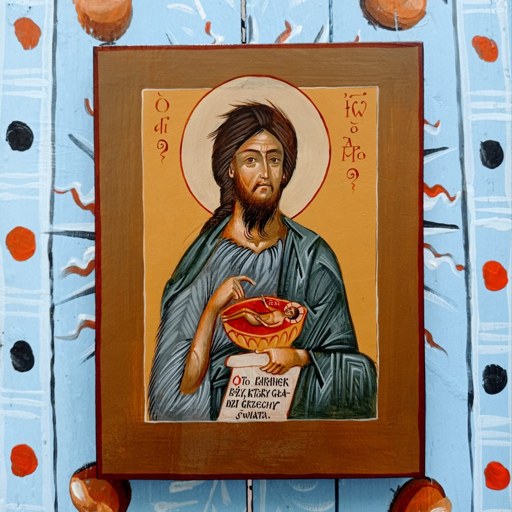
https://www.etsy.com/uk/listing/1518487637/saint-john-the-baptist-picture-icon
License: unknown
Justin
Saint- Feast Day
- 1 June
- Gender
- male
- Church
- Catholic
Places
Roles & Family
Patronage
philosophers;apologists;lecturers
Biography
Saint Justin, known in Christian tradition as Justin Martyr, was a second-century philosopher and apologist and one of the principal Greek Christian writers of the early patristic period. He was born at Flavia Neapolis (modern Nablus) in Samaria, a city refounded as a Roman colony in the first century, in the Roman province later called Syria Palaestina. In the opening of his First Apology he identifies himself as the son of Priscus and grandson of Bacchius. His family was pagan rather than Jewish. Precise years of birth and death are not preserved in contemporary records; modern reference works conventionally place his birth near the beginning of the second century and his martyrdom in the 160s, during the reign of Marcus Aurelius. Justin received a Hellenistic education and, by his own later account in the Dialogue with Trypho, passed through several philosophical schools—Stoic, Peripatetic, and Pythagorean—before attaching himself to Platonism in search of knowledge of God.
His conversion to Christianity followed an encounter, which he narrates as a conversation with an elderly Christian by the sea, a scene later tradition often locates in the region of Ephesus. Thereafter he presented Christianity as the true philosophy and continued to wear the philosopher’s cloak. By the middle of the second century he was teaching in Rome, where he conducted a school. His student Tatian is the best-known of those associated with that circle. The authentic works on which his reputation rests are the First Apology, addressed to Antoninus Pius and the imperial household; a shorter Second Apology, written after the execution of Christians in Rome; and the Dialogue with Trypho, a long disputation with a Jewish interlocutor on the interpretation of the Hebrew Scriptures and the messiahship of Jesus. These texts are primary evidence for second-century baptism and eucharist, for the charges commonly brought against Christians, and for an early Logos theology in which Christ is identified with the divine Word and in which Justin argued that seeds of the Word (logos spermatikos) were already present among the best pagan thinkers.
Justin’s Roman years also involved controversy with other teachers, notably the Cynic Crescens, whom he accused of ignorance and malice; later tradition held that this hostility contributed to his arrest. The Acts of Justin’s martyrdom, a document whose core is generally treated as historically usable, record that Justin and several companions—named as Chariton, Charito, Euelpistus, Hierax, Paeon, and Liberianus—were examined by the urban prefect Junius Rusticus, who held office in the 160s. They refused to sacrifice to the gods and were condemned to death by beheading in Rome. No contemporary source fixes the calendar year; estimates fall in the mid-160s because of Rusticus’s prefecture. Justin was not a bishop, monk, or member of a later religious order, and the sources do not document a wife or children.
Veneration of Justin as a martyr is ancient and does not rest on a medieval papal canonization. His feast is kept on 1 June in the Roman Catholic Church (to which date it was moved in 1969 from 14 April), in the Eastern Orthodox Church, and in other communions. He is invoked as a patron of philosophers and of those who explain and defend the Christian faith. Other writings once circulated under his name, including the Cohortatio ad Graecos and De monarchia, are now generally judged inauthentic. His genuine works remain central for the study of the Church’s encounter with Greco-Roman philosophy and of Christian worship in the second century.