Justinian I is a saint of the Catholic Church (d. 565). Justinian I's feast day is celebrated on 14 November.
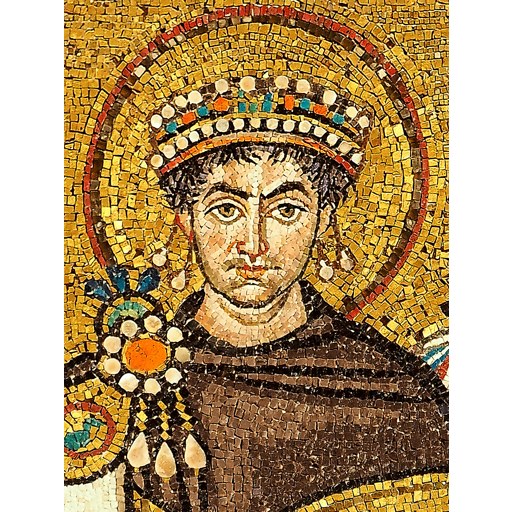
Petar Milošević
License: CC BY-SA 4.0
Justinian I
Saint- Life Span
- d. 565
- Feast Day
- 14 November
- Gender
- male
- Church
- Catholic
Places
Relics & Where to Venerate
Location unknown
The bodily remains of Justinian I are a first-class relic. Venerated at Istanbul.
Roles & Family
Religious Information
Biography
Justinian I, known in Latin as Flavius Petrus Sabbatius Iustinianus, was born in the early 480s at Tauresium in Dardania, a Latin-speaking district of the Balkans within the Eastern Roman Empire. His family was of peasant stock. An uncle, Justin, had risen through military service to high command in Constantinople and, after becoming emperor in 518, brought his nephew into the capital’s elite. Justinian received a substantial education in law, theology, and letters, acted as Justin’s principal counselor, and was crowned co-emperor in 527 shortly before Justin’s death, after which he ruled alone.
In 525 he married Theodora, whose earlier career as an actress made the marriage socially contentious and required a change in the law that had barred men of senatorial rank from wedding actresses. She remained an influential partner in government until her death in 548. Early in the reign the Nika riots of 532, driven by circus factions and senatorial opposition, nearly overthrew the regime; the rising was crushed with a massacre in the Hippodrome. In the aftermath Justinian rebuilt the ceremonial core of Constantinople. The outstanding work of that reconstruction was the new church of Hagia Sophia, whose great dome, completed in the 530s, became the architectural emblem of his age.
The most lasting secular work of the reign was the recodification of Roman law. Imperial commissions produced the Codex Iustinianus, the Digest (Pandects), and the Institutes in the late 520s and 530s, later supplemented by new constitutions known as the Novellae. Together these texts formed the Corpus Iuris Civilis, which governed Byzantine legal practice and, after its medieval revival in the West, deeply influenced the civil-law tradition in Europe. Militarily Justinian pursued the recovery of former Roman lands in the West. Forces under Belisarius destroyed the Vandal kingdom in North Africa in the 530s; a long war under Belisarius and later Narses recovered Italy from the Ostrogoths by the mid-550s; and a foothold was established in southeastern Spain. These campaigns ran alongside wars and diplomacy with Sassanian Persia and a large program of fortification, all at heavy fiscal cost.
Justinian legislated extensively on Christian doctrine and church order, promoted Chalcedonian orthodoxy, closed the remaining pagan philosophical school at Athens, and in 553 convened the Second Council of Constantinople (the Fifth Ecumenical Council) amid the Three Chapters controversy, seeking to hold Miaphysite populations of the eastern provinces without abandoning Chalcedon. The theological settlement was contested and did not heal the divisions. A bubonic plague pandemic, beginning in the early 540s and recurring thereafter, caused enormous mortality and weakened the state. Justinian died in Constantinople in 565 and was buried in the Church of the Holy Apostles. He and Theodora had no children; the throne passed to his nephew Justin II. The Eastern Orthodox Church venerates him as a saint, commemorated on 14 November. His reign is remembered as a concentrated attempt to restore imperial unity in law, building, and territory, achieved only in part and at great strain to the empire’s resources.