Justo Takayama is a blessed of the Catholic Church (1552 - 1615). Justo Takayama's feast day is celebrated on 3 February. Justo Takayama is the patron saint of Japanese Catholics;persecuted Christians.
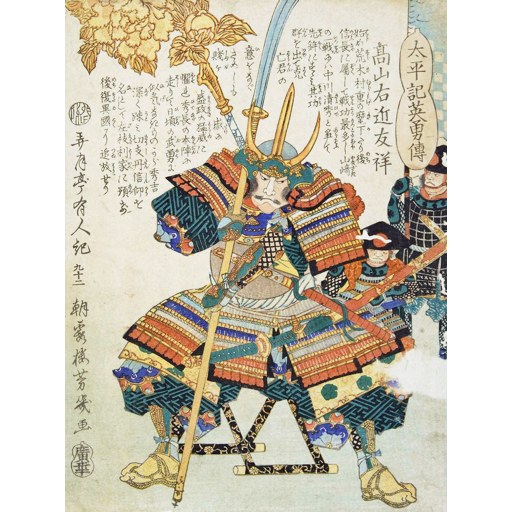
Utagawa Yoshiiku
License: Public domain
Justo Takayama
Blessed- Life Span
- 1552 - 1615 (age 63)
- Feast Day
- 3 February
- Gender
- male
- Church
- Catholic
Places
Roles & Family
Religious Information
Patronage
Japanese Catholics;persecuted Christians
Canonization
Biography
Justo Takayama Ukon, born Hikogorō Shigetomo in 1552 in Japan, was a daimyō and samurai of the Sengoku period and one of the most renowned Japanese converts to Catholicism. He was the son of Takayama Tomoteru, a warrior in central Japan who himself accepted baptism and took the Christian name Dario. The young Takayama was baptized in his early adolescence, around the mid-1560s, receiving the name Justo (Justus). Raised thereafter as a Christian in a household that welcomed Jesuit missionaries, he grew up during the first generations of the Catholic mission in Japan that had begun with Francis Xavier in the mid-sixteenth century. He later succeeded to his father's position and became lord of Takatsuki Castle in Settsu Province, in the region of present-day Osaka Prefecture. Reliable sources disagree on his precise birthplace, with traditions pointing either to the Takatsuki area of Settsu or to Yamato Province.
As lord of Takatsuki, Takayama Ukon openly supported the Church. He permitted and encouraged the building of churches, the work of Jesuit priests, and the conversion of retainers and townspeople, so that his domain became one of the notable Christian centers of late-sixteenth-century Japan. He was also a capable military commander, serving in the campaigns of Oda Nobunaga and subsequently under Toyotomi Hideyoshi, and he was respected as a warrior even by those who did not share his faith. Contemporary missionary letters describe him as devout, attending the sacraments, practicing prayer and penance, and attempting to govern in a manner consistent with Christian moral teaching. He was married to a Christian wife known by the baptismal name Justa, and they had children who were raised in the faith.
In 1587 Toyotomi Hideyoshi issued an edict against the missionaries and ordered Christian lords to abandon the faith. Takayama Ukon refused to apostatize. He was deprived of Takatsuki and of a subsequent holding at Akashi rather than deny Christianity, and he lived thereafter as a masterless samurai. He found protection for a time under other daimyō, notably spending many years in the Kaga domain under Maeda Toshiie and his successors, in the region of present-day Kanazawa. During this long period of dispossession he remained a public Christian, supported missionaries when possible, and became known as an accomplished master of the Japanese tea ceremony, counted among the distinguished disciples of Sen no Rikyū. His reduced circumstances and fidelity over decades made him a prominent example of lay perseverance as persecution intensified.
When Tokugawa Ieyasu promulgated a nationwide prohibition of Christianity in 1614, Takayama Ukon was required to recant or leave Japan. He again refused apostasy and was deported with a group of Japanese Christians to Manila in the Spanish Philippines, arriving in December 1614. Spanish authorities and the Catholic community received him with honor as a noble confessor of the faith. Already advanced in age and weakened by the voyage, he fell ill and died in Manila in early February 1615, only weeks after his arrival. He was buried by the Jesuits in their church of Santa Ana in the city. Because he accepted exile and death rather than renounce Christianity, he has been regarded as a martyr in the sense of one who died in consequence of fidelity to the faith.
Devotion to Takayama Ukon continued among Catholics in Japan and the Philippines. After a long process, Pope Francis authorized his beatification; the solemn celebration was held in Osaka on 7 February 2017, and he is venerated as Blessed Justo Takayama Ukon, with a liturgical memorial on 3 February. He is remembered as a model of the Christian laity, a samurai who placed conscience above rank and property, and a symbol of the early Catholic community in Japan that endured severe persecution in the late sixteenth and early seventeenth centuries. His life is documented in Jesuit missionary correspondence, Japanese historical records of the Sengoku and early Edo periods, and the acts of his beatification cause.