Jutta of Kulmsee is a saint of the Catholic Church (d. 1260). Jutta of Kulmsee's feast day is celebrated on 5 May. Jutta of Kulmsee is the patron saint of Prussia.
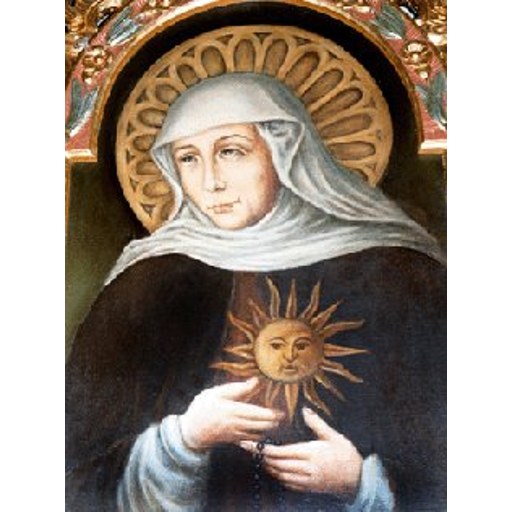
NN
License: Public domain
Jutta of Kulmsee
Saint- Life Span
- d. 1260
- Feast Day
- 5 May
- Gender
- female
- Church
- Catholic
Places
Relics & Where to Venerate
Location unknown
The bodily remains of Jutta of Kulmsee are a first-class relic. Venerated at Co-Cathedral Basilica of the Most Holy Trinity, Chełmża.
Roles & Family
Patronage
Prussia
Biography
Jutta of Kulmsee, also known as Jutta of Sangerhausen, was a thirteenth-century German noblewoman who ended her life as a recluse in Prussia and was thereafter venerated as a saint, above all as a patron of that region. She was born into the nobility at Sangerhausen in Thuringia, within the Holy Roman Empire; the exact year of her birth is not preserved in reliable sources and is only given approximately in later tradition as around the beginning of the thirteenth century. In keeping with the practice of her class she was married young to a nobleman whose personal name is not securely recorded. The marriage produced children. Her husband later died in connection with a journey to the Holy Land, described in the hagiographical tradition as a pilgrimage or crusading expedition, and Jutta was left a widow.
After making provision for her children, she disposed of her property for the benefit of the poor and took up a life of penance, prayer, and works of mercy. Later accounts portray her as caring for the sick, including people afflicted with leprosy, and as practising fasting and other austerities. Her way of life has often been compared with that of Saint Elizabeth of Hungary, another Thuringian noblewoman of the same era whose cult was already spreading after Elizabeth’s death in 1231. Some later writers associated Jutta with the Franciscan Third Order, but early evidence for a formal religious profession or tertiary enrolment is limited, and she is more securely described as a pious widow and, eventually, a hermit rather than as a conventual nun. For a period she remained in her native German lands before seeking a more withdrawn and missionary setting.
In the latter part of her life Jutta went to the Kulmerland (Chełmno Land) in Prussia, then governed by the Teutonic Order and still a frontier of recent and incomplete Christianization. With the consent of the local church, including the bishop of Kulmsee, she settled as a recluse at Bielczyny, near the cathedral town of Kulmsee (present-day Chełmża in Poland). There she combined eremitical solitude with charity toward the surrounding population. Medieval notices are sparse; later legend elaborates her role as counsellor and example among Prussians living under the new ecclesiastical and military order. She did not found a lasting religious community, and her vocation remained that of an anchoress or hermit attached to the cathedral church rather than that of an abbess or itinerant missionary.
According to the date transmitted by her cult, Jutta died at her hermitage on 12 May 1260. She was buried in the cathedral of the Holy Trinity at Kulmsee, where her tomb became a centre of local veneration. The Teutonic Knights and the bishops of Kulm fostered her memory, and she came to be honoured as a heavenly patron of Prussia. She was never the subject of a formal papal canonization of the later medieval or Tridentine type; her reputation as a saint rests on continuous local cult and on later liturgical commemoration, commonly kept on 5 May. Surviving knowledge of her life is modest and is filtered through hagiography composed or expanded after her death, but the outline of a Thuringian widow who spent her last years as a recluse in Prussia is consistent in the principal traditions attached to her name.