Karoli Lwanga is a saint of the Catholic Church (d. 1886). Karoli Lwanga's feast day is celebrated on June 3. Karoli Lwanga is the patron saint of African Catholic Youth Action;converts;torture victims;African youth.
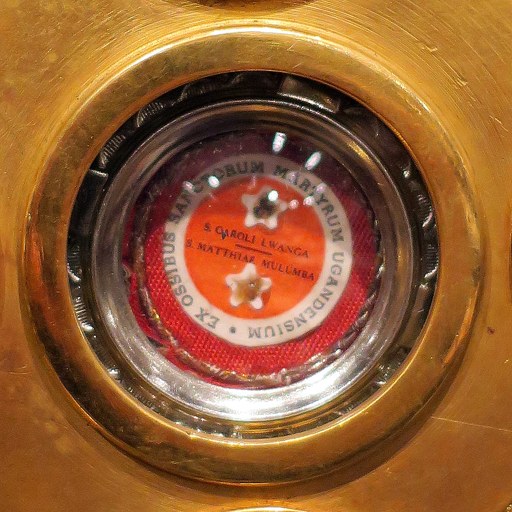
Nheyob
License: CC0
Karoli Lwanga
Saint- Life Span
- d. 1886
- Feast Day
- June 3
- Gender
- male
- Church
- Catholic
Places
Roles & Family
Patronage
African Catholic Youth Action;converts;torture victims;African youth
Canonization
Biography
Charles Lwanga, known in Luganda as Karoli or Kaloli Lwanga, was a Catholic convert and martyr of the Kingdom of Buganda in the late nineteenth century and the most prominent of the Uganda Martyrs. He was born in the 1860s into a family of the Ngabi clan in Buganda, in the Great Lakes region of East Africa that later became part of Uganda. Precise records of his birth year and village are lacking; modern notices commonly give 1860 or 1865. As a youth he entered the royal court of the kabaka, serving among the pages, a corps of young men who attended the king and were trained for future office. Under Kabaka Mwanga II, who succeeded his father Mutesa I in 1884, Lwanga rose to become chief of these pages. The Buganda court in the 1880s was a focus of intense religious and political rivalry. Mutesa had admitted Anglican missionaries of the Church Missionary Society and Catholic Missionaries of Africa (the White Fathers) as well as Muslim teachers; Mwanga’s reign saw that competition turn violent as the king sought to reassert traditional authority against the new faiths and against the growing shadow of European power.
Lwanga came under the influence of the Catholic mission and of Joseph Mukasa Balikuddembe, a senior Catholic who had served at court under Mutesa and who was chief of the pages before him. Mukasa was executed on 15 November 1885 after he reproached the king for the murder of the Anglican bishop James Hannington and for the sexual abuse of the pages. That same day Lwanga, who succeeded Mukasa in charge of the pages, was baptized, taking the name Charles. He thereafter acted as a catechist among the younger attendants: he taught them the Catholic faith, prepared them for baptism, and protected them from Mwanga’s demands for sexual relations, which the Christian pages refused. The king’s anger was thus both personal and political. He regarded the Christians’ disobedience as a challenge to royal power and feared that converts were a fifth column for foreign influence.
In late May 1886 Mwanga ordered the Christian pages to be assembled and condemned those who would not recant. Before the group was removed from the capital, Lwanga baptized several of the catechumens, among them the boy Kizito. The prisoners were marched to Namugongo, the traditional place of execution by burning. On 3 June 1886 Lwanga was taken aside and burned to death on a slow fire; the other condemned, Catholics and Anglicans together, were burned on a large pyre. He was still in his twenties. Missionary reports compiled soon afterward, and the later acts of the martyrs, describe him as encouraging his companions and dying with a confession of Christian faith. In the wider persecution of 1885–1887, twenty-two Catholics were put to death in Buganda, together with a similar number of Anglicans; the Catholic victims, with Lwanga as their leading figure, became known as the Uganda Martyrs.
Devotion to the martyrs grew in the Catholic Church in Africa and beyond. The twenty-two were beatified by Pope Benedict XV on 6 June 1920 and canonized by Pope Paul VI on 18 October 1964, in a ceremony during the Second Vatican Council that was widely noted as a recognition of the African church. Paul VI visited Uganda in 1969 and prayed at Namugongo, the first reigning pope to travel to sub-Saharan Africa. Charles Lwanga and his companions are commemorated on 3 June in the General Roman Calendar. Lwanga is invoked as a patron of African Catholic youth and of African Catholic Youth Action, of converts, and of victims of torture. The Basilica of the Uganda Martyrs, built at Namugongo on the site of the executions, is among the principal pilgrimage churches of Africa, drawing large crowds each year on the martyrs’ feast.