Katharine Drexel is a saint of the Catholic Church (1858 - 1955). Katharine Drexel's feast day is celebrated on March 3. Katharine Drexel is the patron saint of racial justice;philanthropists.
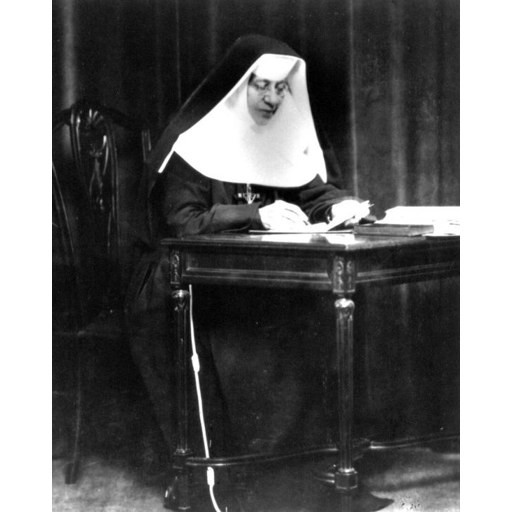
Unknown authorUnknown author
License: Public domain
Katharine Drexel
Saint- Life Span
- 1858 - 1955 (age 97)
- Feast Day
- March 3
- Gender
- female
- Church
- Catholic
Places
Relics & Where to Venerate
Location unknown
A second-class relic of Drexel is located inside the altar of the Mary Chapel at St
Housed at Basilica of Saint Mary · Spain
A second-class relic of Drexel is located inside the altar of the Mary Chapel at St
Roles & Family
Religious Information
Patronage
racial justice;philanthropists
Canonization
Biography
Katharine Mary Drexel was born in Philadelphia, Pennsylvania, in 1858, the second daughter of Francis Anthony Drexel, a leading Philadelphia banker and partner in Drexel and Company, and Hannah Langstroth Drexel. Her mother died a few weeks after her birth. Francis Drexel subsequently married Emma Bouvier, who raised Katharine together with her older sister Elizabeth and their younger half-sister Louise in a household marked by regular prayer, frequent reception of the sacraments, and systematic private charity. Three days a week the Drexel home received the poor of the city, and the family distributed food, clothing, and rent assistance. Katharine was educated privately and traveled extensively in the United States and Europe, experiences that formed both her piety and her awareness of social conditions beyond her own class.
After Emma Drexel died in 1883 and Francis Drexel in 1885, the three sisters inherited a fortune that made Katharine one of the wealthiest women in the country. Tours of the American West in the mid-1880s confronted her with the poverty of Native American reservations, and she became equally concerned about the denial of education and pastoral care to African Americans in the South. She began to fund missions and schools from her own income. In 1887, during an audience in Rome, she asked Pope Leo XIII to send missionaries to the Native American missions; he replied by suggesting that she herself become a missionary. After further discernment she entered the novitiate of the Sisters of Mercy in Pittsburgh in 1889. On 12 February 1891 she professed vows and founded the Sisters of the Blessed Sacrament for Indians and Colored People, taking the religious name Mother Katharine. The congregation added to the traditional vows a commitment to serve Native Americans and African Americans.
From the motherhouse later established at Cornwells Heights in Bensalem Township, Pennsylvania, Mother Katharine used her inheritance and the labor of her sisters to found and staff schools, churches, and missions across the United States. The most prominent of these works was Xavier University of Louisiana in New Orleans, begun as a preparatory school in 1915 and opened as a four-year college in 1925; it remains the only historically Black Catholic university in the United States. Her sisters taught on reservations in the West and in segregated schools in the South, often amid local opposition. She insisted that Eucharistic devotion stand at the center of the congregation's life and that education be treated as a primary instrument of justice and evangelization. By the time ill health forced her from active administration, the Sisters of the Blessed Sacrament had opened dozens of schools and numerous missions serving Native American and African American communities.
A heart attack in 1935 ended Mother Katharine's years of travel and governance. She spent her last two decades in prayer and correspondence at the Pennsylvania motherhouse and died there on 3 March 1955 at the age of ninety-six. Two healings from deafness were accepted as miracles for her cause. Pope John Paul II beatified her in 1988 and canonized her on 1 October 2000, making her the second native-born citizen of the United States to be declared a saint. Her feast is kept on 3 March. She is honored as a patron of racial justice and of philanthropists. After the sale of the former motherhouse, her remains were transferred to a shrine in the Cathedral Basilica of Saints Peter and Paul in Philadelphia.