Kigwe is a saint of the Catholic Church. Kigwe is the patron saint of St Kew, Cornwall;Llangua (Llangiwa), Monmouthshire.
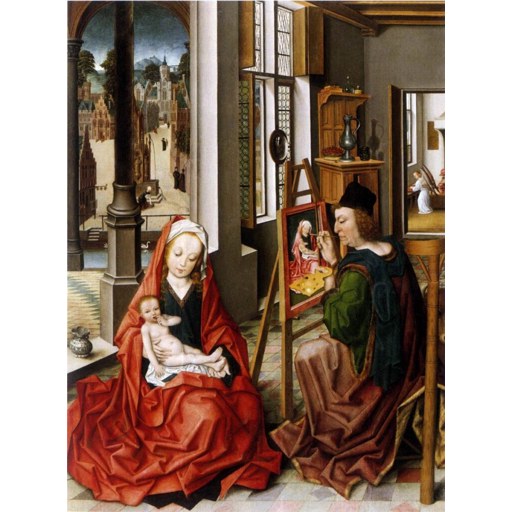
https://dailyartmagazine.com/saint-luke-the-ultimate-holy-painter
License: unknown
Kigwe
Saint- Gender
- female
- Church
- Catholic
Roles & Family
Patronage
St Kew, Cornwall;Llangua (Llangiwa), Monmouthshire
Biography
Saint Kigwe, whose name appears in various forms including Ciwa, Kew, Cigwa, and Kigwa, was a female saint of the early medieval Celtic church in western Britain. She is generally placed in the fifth or sixth century, though no contemporary written sources mention her and no precise dates for her birth or death can be established. Her historical existence is inferred from church dedications and place-names rather than from a surviving vita or martyrological entry of early date. The two principal locations associated with her cult are the parish of St Kew in Cornwall and Llangua (Welsh Llangiwa) in Monmouthshire, suggesting either a single figure whose cult spread across the Severn Sea or two similarly named holy women later conflated in tradition.
Later medieval and early modern antiquarian accounts identify Kigwe as the sister of Saint Docco (also called Dochau or, in some sources, Cyngar), a monastic founder linked to the same Cornish site. According to one version of the story, Docco established a religious house at what became St Kew, but the local people showed greater devotion to his sister, whose reputation for holiness overshadowed his own; he is said to have departed as a result. Sibling pairs of saints are a recurring feature of Celtic hagiography, and such narratives often serve to explain dual dedications or competing cults rather than to record verifiable biography. No independent early evidence confirms the relationship.
In Wales, the place-name Llangiwa preserves her name in the element -giwa. The church there, though later rededicated, points to an early cult centre. Some compilers of Welsh saintly genealogies, working in the later Middle Ages, attempted to insert Ciwa among the numerous children attributed to Brychan of Brycheiniog, a legendary fifth-century ruler whose progeny were said to have evangelized large parts of Wales and beyond. These genealogies are widely regarded by modern historians as largely artificial constructions and cannot be used to establish her parentage or social rank with any confidence. Nothing reliable is known of her family, education, or the specific form of religious life she followed, though she is consistently presented as a consecrated woman rather than a married foundress.
Kigwe was never the subject of a formal process of canonization by the papacy; like the great majority of British and Irish saints of the early Middle Ages, her sanctity was recognized through local liturgical commemoration and popular devotion, a pattern later termed equipollent or pre-Congregation canonization. No universally observed feast day is recorded in the major martyrologies. Details of her death, burial, and any miracles attributed to her in her lifetime or afterwards have not been preserved in sources that meet ordinary historical criteria. She remains an obscure figure whose importance lies chiefly in the toponymic and dedicatory evidence that attests to the presence of female religious leadership in post-Roman western Britain.