Konstantinos of Hydra, Neo-Martyr is a saint of the Catholic Church (d. 1800). Konstantinos of Hydra, Neo-Martyr's feast day is celebrated on 14 November. Konstantinos of Hydra, Neo-Martyr is the patron saint of Hydra.
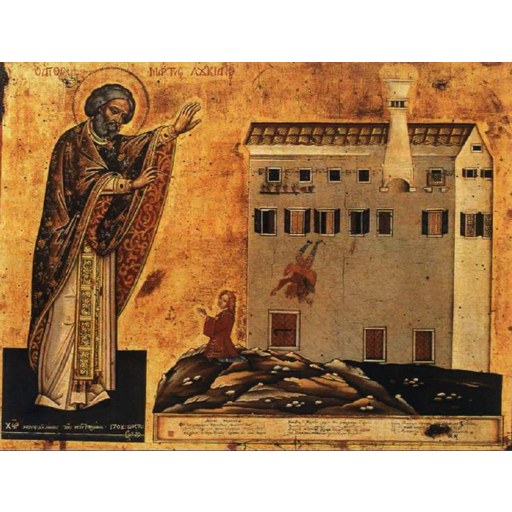
https://en.wikipedia.org/wiki/Konstantinos_Kontarinis
License: unknown
Konstantinos of Hydra, Neo-Martyr
Saint- Life Span
- d. 1800
- Feast Day
- 14 November
- Gender
- male
- Church
- Catholic
Places
Roles & Family
Patronage
Hydra
Biography
The New Martyr Constantine of Hydra is an Orthodox Christian saint of the late Ottoman period whose life is known chiefly from Greek hagiographical tradition rather than from contemporary archival documents. He was born on the island of Hydra in the Aegean, then under Ottoman rule, and was raised in a Christian family. The exact year of his birth is not securely documented in independent historical sources, though later church tradition sometimes places it in the later eighteenth century. As a young man he left Hydra for Rhodes in search of work. Living as a Christian subject in a predominantly Muslim urban setting, he converted to Islam. Surviving accounts do not agree on every circumstance of that conversion; they present it as a fall under social and political pressure rather than as a lengthy intellectual apostasy, a pattern familiar among the neo-martyrs of the eighteenth century.
Remorse followed. Constantine left Rhodes and returned to Hydra, then proceeded to Mount Athos, the principal centre of Orthodox monasticism in the Greek world. According to the received synaxarion tradition, he entered the Skete of Saint Anna, confessed his denial of Christ to a spiritual father, and submitted to a period of repentance and ascetic discipline. In keeping with the pastoral practice of the time toward those who had accepted Islam and later sought reconciliation with the Church, he received a blessing to return to the place where he had abandoned the faith and to confess Christ in public, accepting the likelihood of death. The Athos sojourn is central to his memory: it frames his martyrdom as the fruit of repentance rather than as a sudden impulse.
He traveled to Rhodes and there openly proclaimed that he was a Christian named Constantine, a native of Hydra, and that he rejected Islam. He was arrested, imprisoned, and examined by the Ottoman authorities, who sought to have him return to Islam. He refused. He was condemned and beheaded in Rhodes on 14 November 1800. His death belongs to the large company of Orthodox neo-martyrs who suffered in the last century of Ottoman rule in the Greek lands—men and women who had either been born Christian and converted under duress or who, after a fall, chose public confession.
Veneration of Constantine spread among the Orthodox of the Aegean and especially on Hydra, which regards him as one of its own and where a church was later associated with his memory. He is commemorated in the Orthodox liturgical calendar on 14 November. He did not hold episcopal, patriarchal, or papal office. Historical caution is required: almost everything that can be said about his inner life, the names of his parents, any possible marriage, or the precise original burial of his body rests on later pious narrative rather than on independently verified records. What the tradition preserves with consistency is his Hydriot origin, his apostasy and repentance, his connection with Mount Athos, and his execution at Rhodes in 1800.