Kostanti-Kakhay is a saint of the Catholic Church (d. 853). Kostanti-Kakhay's feast day is celebrated on 10 November.
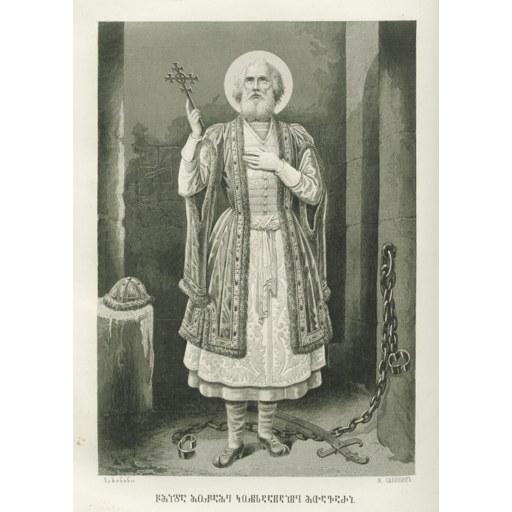
Mikhail Sabinin
License: Public domain
Kostanti-Kakhay
Saint- Life Span
- d. 853
- Feast Day
- 10 November
- Gender
- male
- Church
- Catholic
Places
Roles & Family
Biography
Kostanti-Kakhay, also known as Konstanti Kakhi or Constantine of Kakheti, was a ninth-century Georgian nobleman and military commander from the eastern Georgian province of Kakheti. He is venerated as a Christian martyr by the Georgian Orthodox Church. Almost all that can be said of him rests on a Georgian hagiographical narrative, the Martyrdom of Konstanti Kakhi, which appears to have been written relatively soon after his death, and on related notices in the medieval Georgian historical tradition. These texts describe him as a man of distinguished Kakhetian birth and as a warrior of established reputation. The vita further states that he was already of great age—eighty-five years—when he was put to death; that figure belongs to the hagiographical tradition and cannot be confirmed independently, so his year of birth remains unknown.
The political setting of his martyrdom was the mid-ninth-century struggle between the Abbasid Caliphate and the Christian and Muslim elites of the Caucasus. Much of eastern Georgia then lay under Arab suzerainty, with a Muslim emirate based at Tbilisi, while Kakheti retained a measure of local autonomy under its own princes and chorepiscopi. In 853 the caliph al-Mutawakkil sent the Turkish general Bugha al-Kabir, known as Bugha the Turk, on a large punitive expedition into Armenia and Georgia. Arabic historians record the same campaign: Tbilisi was stormed, the rebellious emir Ishaq ibn Isma'il was executed, and the country was laid waste. Georgian sources add that many nobles were seized. Konstanti Kakhi was among those taken prisoner during the invasion of Kakheti and Kartli.
The captives were deported to the Abbasid court, then residing at Samarra on the Tigris in present-day Iraq. There, according to the martyrdom account, Konstanti was brought before the caliph and urged to renounce Christianity and accept Islam, with offers of rank and favor. He refused, professing that he had been a Christian all his life and would not deny Christ. The hagiographer describes imprisonment and torture followed by execution by beheading when he remained steadfast. His death is dated to 853, the year of Bugha’s well-attested Caucasian campaign, and is placed in November by the martyrdom tradition and later liturgical calendars.
From the Middle Ages the Georgian Orthodox Church has commemorated Konstanti Kakhi as a saint and great martyr. His feast day is 10 November. The Martyrdom of Konstanti Kakhi is counted among the notable monuments of ninth-century Georgian literature and is of interest to historians of Arab–Georgian relations, although, like other works of its genre, it combines a historical core with edifying dialogue and conventional scenes of interrogation and passion. No reliable evidence survives concerning his marriage, children, or the place of his burial, and he held no episcopal or patriarchal office. He is remembered as a lay nobleman who died for his faith rather than as a monk or hierarch.