Kuksha of Odessa is a saint of the Catholic Church (1875 - 1964). Kuksha of Odessa's feast day is celebrated on 16 September and 24 December.
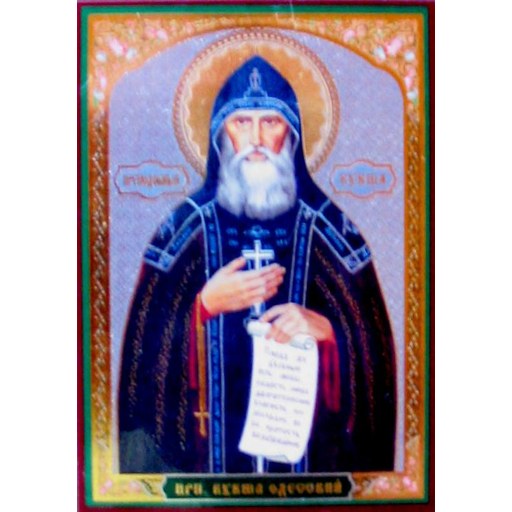
Roman Zacharij
License: CC BY-SA 3.0
Kuksha of Odessa
Saint- Life Span
- 1875 - 1964 (age 89)
- Feast Day
- 16 September and 24 December
- Gender
- male
- Church
- Catholic
Places
Relics & Where to Venerate
Location unknown
The bodily remains of Kuksha of Odessa are a first-class relic. Venerated at Dormition Monastery.
Roles & Family
Religious Information
Canonization
Biography
Kuksha of Odessa was born Kosma Kirillovich Velichko on 12 January 1875 in the village of Arbuzinka (also given in some sources as Garbuzinka), in the Elisavetgrad district of Kherson Governorate in the Russian Empire, territory that now lies in southern Ukraine. He came from a pious peasant family; his parents, Kirill and Kharitina Velichko, raised him in the Orthodox Christian faith, and later accounts of his life describe his mother as eventually taking the monastic habit. From childhood he was drawn to prayer and pilgrimage. In his youth he traveled to the shrines of Kiev and then undertook a long journey to Jerusalem and Mount Athos, experiences that confirmed his intention to enter monastic life rather than remain in the world.
In 1896 he was received as a novice at the Kiev Pechersk Lavra, the historic cave monastery that had long been a spiritual center of Eastern Slavic Orthodoxy. After a period of compulsory military service he returned to the Lavra. In 1913 he was tonsured a monk with the name Xenophon and was subsequently ordained to the diaconate and then to the priesthood, serving the brotherhood as a hieromonk. The Bolshevik Revolution and the Soviet campaign against the Church shattered the Lavra’s communal life. The monastery was closed, its monks dispersed, and Xenophon, like many clergy of his generation, was subjected to arrest, interrogation, imprisonment in labor camps, and internal exile during the 1930s and 1940s. Surviving notices of his life place him in camps and remote settlements in the Urals and elsewhere in the Soviet interior before he was able to resume open monastic service after the Second World War.
In the late 1940s he lived for a time at the Pochaev Lavra in western Ukraine. There, according to the tradition of his Life, he received the great schema and the name Kuksha, recalling the medieval missionary monk Kuksha of the Kiev Caves. In the 1950s he was moved among remaining legal monastic houses and was finally settled at the Holy Dormition Monastery in Odessa. In that community, despite age, illness, and the restrictions of Soviet religious policy, he became known as an elder, or starets: a spiritual father to whom clergy and laypeople came for confession, counsel, and prayer. Contemporary witnesses described him as austere, humble, and gifted with discernment; he was sought as a healer and as one who could perceive hidden spiritual states. He spent long hours in the church and in his cell, receiving visitors when his strength allowed.
Kuksha died at the Odessa monastery on 24 December 1964 and was buried in the monastery cemetery. After the collapse of Soviet restrictions, his relics were uncovered in 1994 and were reported incorrupt. The Ukrainian Orthodox Church of the Moscow Patriarchate glorified him as a saint in 1994. His relics are enshrined at the Holy Dormition Monastery in Odessa. He is commemorated on 16 September, the day associated with the uncovering of his relics, and on 24 December, the day of his repose. He is venerated especially in Ukraine and among Orthodox Christians of the former Russian Empire as a confessor who endured Soviet persecution and as a twentieth-century monastic elder and wonderworker.