Kyrion II is a saint of the Catholic Church (1855 - 1918).
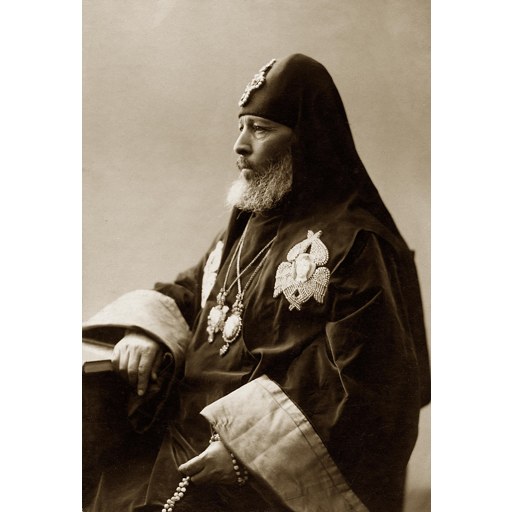
Unknown authorUnknown author
License: Public domain
Kyrion II
Saint- Life Span
- 1855 - 1918 (age 63)
- Gender
- male
- Church
- Catholic
Places
Relics & Where to Venerate
Location unknown
The bodily remains of Kyrion II are a first-class relic. Venerated at Sioni Cathedral.
Roles & Family
Canonization
Biography
Kyrion II, born Giorgi Sadzaglishvili in 1855 in the village of Nikozi in the Gori district of Georgia, then part of the Russian Empire, was a Georgian Orthodox hierarch, church historian, and the first Catholicos-Patriarch of All Georgia after the restoration of the Church's autocephaly in 1917. The son of a parish priest, he was educated at the Tiflis Theological School and the Tiflis Theological Seminary and completed higher studies at the Kiev Theological Academy, graduating in 1880. He then taught in theological schools in Georgia and became known as a scholar of Georgian ecclesiastical history, archaeology, and hagiography. His publications and archival work belonged to the broader Georgian national and cultural revival of the late nineteenth century, when clergy and lay intellectuals sought to recover the country's medieval Christian past under imperial Russian rule.
Ordained and later tonsured as a monk, he rose through the clergy of the Georgian Exarchate of the Russian Orthodox Church and was consecrated a bishop before the end of the nineteenth century. He served in several Georgian sees, including Alaverdi and Gori. Throughout his career he was a leading advocate of restoring the autocephaly of the Georgian Orthodox Church, which the Russian imperial government had abolished in 1811 when it replaced the Catholicos-Patriarch with a Russian exarch. That stance brought him into conflict with the imperial ecclesiastical authorities. After the assassination of Exarch Nikon in 1908, Kyrion and other Georgian bishops were treated with suspicion; he was removed from Georgia and assigned to dioceses in the interior of the Russian Empire, a period often described as exile.
The collapse of tsarist authority in 1917 allowed the Georgian episcopate and clergy to proclaim the restoration of autocephaly in March of that year. A church council subsequently elected Kyrion as Catholicos-Patriarch of All Georgia, and he was enthroned at Svetitskhoveli Cathedral in Mtskheta, the ancient patriarchal seat. His patriarchate coincided with Georgia's brief emergence as an independent republic amid war and revolution. The newly restored church had to reorganize its administration, assert its independence from the Russian Church, and navigate sharp political and ecclesiastical divisions in a country still at war and in social upheaval.
Kyrion II's tenure lasted less than a year. On 26 June 1918 he was found dead of a gunshot wound at his residence at the Martqopi Monastery near Tbilisi. The assassination was never solved. Contemporaries and later historians have suggested internal church conflict, political motives, or the general chaos of the revolutionary years, but no perpetrator was identified. He was buried at Martqopi. In 2002 the Holy Synod of the Georgian Orthodox Church glorified him as a hieromartyr. He is remembered as a scholar-bishop, a central figure in the recovery of Georgian autocephaly, and a martyr of the church in a violent year of revolution and national independence.