Lambert of Saragossa is a saint of the Catholic Church. Lambert of Saragossa's feast day is celebrated on 16 April.
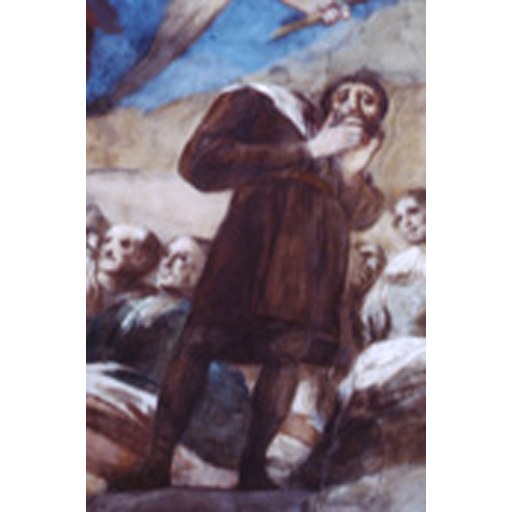
Francisco Goya
License: Public domain
Lambert of Saragossa
Saint- Feast Day
- 16 April
- Gender
- male
- Church
- Catholic
Places
Roles & Family
Biography
Lambert of Saragossa, known in Spanish as Lamberto de Zaragoza, is a Christian martyr associated with the city of Zaragoza (Saragossa) in Aragon, in northeastern Spain. Later liturgical notices and hagiographical handbooks generally place him in the eighth century, in the generation after the Muslim conquest of the Iberian Peninsula, when Zaragoza had passed under Umayyad rule. No contemporary chronicle, inscription, or archival document names him, and the surviving narrative of his death is a medieval passion of legendary character. He is therefore known almost entirely through later cult and martyrological commemoration rather than through recoverable biography. He is distinct from the far more widely attested Saint Lambert of Maastricht (Liège), the seventh-century bishop whose feast falls in September.
The principal medieval account presents Lambert as a Christian living at Zaragoza in a subordinate, laboring position in a Muslim household. While his master was away, traditionally on a journey toward Córdoba, Lambert is said to have given himself to prayer and to have left the agricultural work expected of him undone. On the master’s return he was put to death, according to the legend by the sword. The same tradition adds that the body was thrown into the river Ebro and afterward recovered by Christians for burial. Some later notices call him a deacon of the church of Zaragoza rather than a domestic servant; the two characterizations sit side by side in the secondary literature and cannot both be controlled by early evidence. The passion belongs to a familiar type of late legendary martyr-story and cannot be used as a factual record of events, names, or motives.
What can be said with more caution is that a local cult of a martyr named Lambert existed at Zaragoza and that he was entered in martyrologies and local calendars as a saint of that city. The commemoration is assigned to 16 April. Recognition of his sanctity belongs to the older pattern of local liturgical cult rather than to a documented papal canonization of the later medieval or modern procedure; no reliable source names a canonizing or beatifying pontiff. Parentage, year of birth, marital status, and place of burial are not recorded in sources that can be checked. Modern summaries therefore treat him as an obscure Spanish martyr of Zaragoza, noting the eighth-century setting given by tradition, the legendary form of the passion, and the persistence of his name in the religious memory of the city, including later parish dedications, while declining to reconstruct a detailed life that the evidence does not support.