Laurence is a saint of the Catholic Church (d. 258). Laurence's feast day is celebrated on 10 August. Laurence is the patron saint of Rome;deacons;the poor;cooks;chefs;comedians;librarians;archivists;students;tanners;brewers;confectioners;firefighters;against fire;against lumbago;Huesca;Sri Lanka.
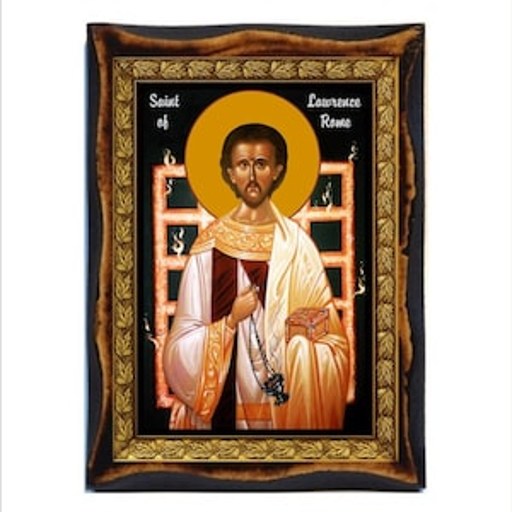
https://www.etsy.com/market/st_lawrence_icon
License: unknown
Laurence
Saint- Life Span
- d. 258
- Feast Day
- 10 August
- Gender
- male
- Church
- Catholic
Places
Roles & Family
Patronage
Rome;deacons;the poor;cooks;chefs;comedians;librarians;archivists;students;tanners;brewers;confectioners;firefighters;against fire;against lumbago;Huesca;Sri Lanka
Biography
Saint Laurence (Latin Laurentius), commonly called Lawrence of Rome, was a deacon of the Roman Church and among the most celebrated martyrs of the third century. No contemporary document records the year of his birth. A tradition already known to the Spanish Christian poet Prudentius in the late fourth century made him a native of Hispania; later medieval sources specified Huesca in what is now Aragon. He is associated in all early accounts with Pope Sixtus II, who is said to have ordained him and appointed him archdeacon of Rome, with charge of the Church's treasury and of relief for the city's poor.
During the persecution of Christians decreed by the emperor Valerian, Sixtus II was arrested in August 258 while celebrating the liturgy in a cemetery and was executed on 6 August with several companions. According to the narrative known to Saint Ambrose of Milan a little more than a century later, the civil authorities then demanded that Laurence hand over the riches of the Church. He obtained a brief delay, gave what remained to the needy, and on the appointed day presented the poor, the lame, and the blind as the Church's true treasure. The prefect, in the later legendary Acta, had him scourged and roasted to death on a gridiron on 10 August 258. Historians generally accept that a Roman deacon named Laurence was martyred in the Valerian persecution within days of Sixtus II; they treat the gridiron, the three-day delay, and the famous remark that the victim was done on one side and should be turned as later hagiographical development rather than as courtroom fact.
The cult of Laurence is exceptionally early and well attested. The Depositio martyrum contained in the Chronograph of 354 already lists his feast on 10 August. The emperor Constantine built a basilica over the tomb on the Via Tiburtina outside the walls; the church, rebuilt in subsequent centuries, is the present Basilica of San Lorenzo fuori le Mura, one of the seven pilgrimage churches of Rome and the traditional place of his burial. His name entered the Roman Canon of the Mass. Dedications to him spread rapidly through Italy, Gaul, Spain, and the rest of the Latin West, making him one of the most popular saints of the Middle Ages.
In art he appears as a youthful deacon in a dalmatic, holding a gridiron and often a book or a purse of alms. He is a principal patron of Rome and is invoked by deacons, by those who care for the poor, and by numerous trades and groups connected with fire, cooking, books, and comedy. Because the earliest witnesses are liturgical calendars and fourth-century preaching and poetry rather than official acts of 258, a careful biography distinguishes the historically secure core—a Roman deacon put to death in 258—from the colourful legend that grew around him and that nonetheless shaped Christian devotion for sixteen centuries.