Laurent-Joseph-Marius Imbert is a saint of the Catholic Church (1796 - 1839). Laurent-Joseph-Marius Imbert's feast day is celebrated on 20 September.
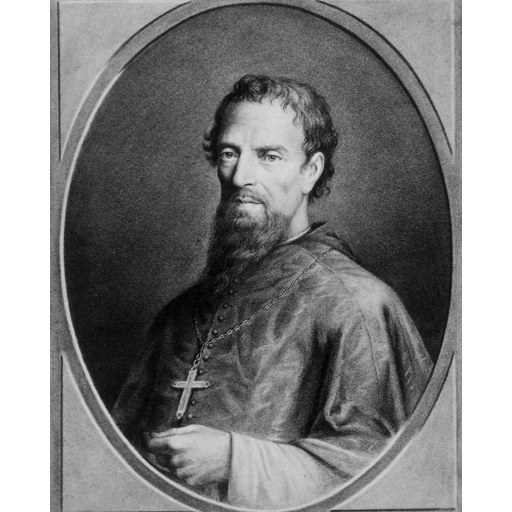
Unknown authorUnknown author
License: Public domain
Laurent-Joseph-Marius Imbert
Saint- Life Span
- 1796 - 1839 (age 43)
- Feast Day
- 20 September
- Gender
- male
- Church
- Catholic
Places
Roles & Family
Religious Information
Canonization
Biography
Laurent-Joseph-Marius Imbert was a French Catholic missionary bishop and martyr of the nineteenth century, born in 1796 at Marignane in Provence, in southern France. He pursued priestly studies and joined the Paris Foreign Missions Society (Société des Missions Étrangères de Paris), a society of apostolic life devoted to overseas evangelization. He was ordained to the priesthood in 1819 and was assigned to the China mission. For many years he labored in the interior of China, particularly in Sichuan, where he learned Chinese, served scattered Christian communities, and worked under the restrictions that the Qing empire placed on foreign missionaries and on the practice of Christianity.
In 1836 Imbert was named Vicar Apostolic of Korea and titular Bishop of Capsa. Korea, then under the Joseon dynasty, forbade Christianity and excluded most foreigners; earlier efforts to place resident clergy in the country had ended in martyrdom or expulsion. After episcopal consecration in China, he crossed the border in secret in 1837 and became the first bishop to reside in Korea. He lived in concealment, often in disguise, together with two fellow priests of the Paris Foreign Missions Society, Pierre-Philibert Maubant and Jacques-Honoré Chastan. They administered the sacraments, trained catechists, and supported a Korean Catholic community that had arisen in the late eighteenth century largely through lay initiative and contacts with China, and that already numbered several thousand despite repeated persecutions.
In 1839 the Gihae persecution, one of the most severe anti-Christian campaigns of the Joseon period, broke out. Officials hunted priests and leading lay Catholics. Imbert concluded that the presence of hidden foreign clergy was bringing further suffering on Korean families who sheltered them. He therefore surrendered to the authorities and wrote to Maubant and Chastan urging them to do the same, hoping that their surrender might lessen the violence against the faithful. The three missionaries were imprisoned in Seoul, interrogated, and tortured. On 21 September 1839 they were taken to the execution ground at Saenamteo, by the Han River, and beheaded. Many Korean Catholics, among them the catechist Paul Chong Hasang and others later canonized with them, were put to death in the same wave of persecution.
Imbert and his companions were beatified by Pope Pius XI on 5 July 1925 among a large group of Korean martyrs. On 6 May 1984 Pope John Paul II canonized 103 Korean Martyrs, including Imbert, during a Mass in Seoul. In the liturgical calendar of the Catholic Church they are commemorated together on 20 September. Imbert is remembered as the first bishop of the Korean mission and as a pastor who chose to share the fate of his flock. His life belongs both to the history of French missionary expansion in East Asia in the nineteenth century and to the memory of the Korean Catholic community under state persecution.