Lawrence Giustiniani is a saint of the Catholic Church (1381 - 1456). Lawrence Giustiniani's feast day is celebrated on 8 January.
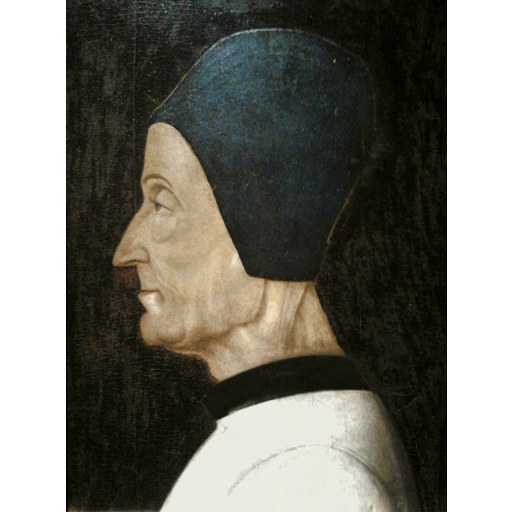
Gentile Bellini
License: Public domain
Lawrence Giustiniani
Saint- Life Span
- 1381 - 1456 (age 75)
- Feast Day
- 8 January
- Gender
- male
- Church
- Catholic
Places
Relics & Where to Venerate
Location unknown
The bodily remains of Lawrence Giustiniani are a first-class relic. Venerated at San Pietro di Castello.
Roles & Family
Religious Information
Canonization
Biography
Lawrence Justinian (Italian: Lorenzo Giustiniani) was born in 1381 in Venice, a member of the noble Giustiniani family of the Venetian Republic. Left fatherless while still young, he grew up in a household noted for piety. In late adolescence he turned toward a strictly religious life, and at about the age of nineteen he entered the Congregation of Canons Regular of San Giorgio in Alga, a community of canons living in common on an island in the Venetian lagoon according to the Rule of St. Augustine. That congregation, with which the future Pope Eugene IV was associated in its early years, emphasized liturgical prayer, clerical reform, and pastoral work. Lawrence was ordained priest and became known for fasting, night prayer, and care of the poor of Venice.
He served as prior in houses of his congregation and was later elected its superior general, working to maintain regular discipline. In 1433 Pope Eugene IV appointed him Bishop of Castello, the see that served the city of Venice. As bishop he carried out visitations, sought to reform the morals of clergy and people, and directed substantial charity toward the sick and destitute, while retaining the simple habits of a canon regular. Accounts from his own century stress his accessibility and his insistence that ecclesiastical office was a burden of service rather than a source of display.
In 1451 Pope Nicholas V suppressed the Patriarchate of Grado and the Diocese of Castello and erected the Patriarchate of Venice, naming Lawrence its first patriarch. He held that Latin Catholic dignity until his death, continuing the same program of reform and personal austerity. He was also a spiritual writer; works circulating under his name include treatises on the union of the soul with the Word, on the duties of prelates, and on Christian perfection, which later found readers among clergy and religious. He died in Venice on 8 January 1456 and was buried in the cathedral church of San Pietro di Castello.
Veneration of Lawrence began in Venice soon after his death. He was beatified by Pope Clement VII in 1524 and canonized by Pope Alexander VIII in 1690. His liturgical memorial is observed on 8 January, the day of his death; in some older Roman calendars it was kept on 5 September. He is remembered as a reforming bishop and mystic of fifteenth-century Venice and as the first occupant of the Venetian patriarchate.