Leo is a saint of the Catholic Church (d. 461). Leo's feast day is celebrated on 10 November.
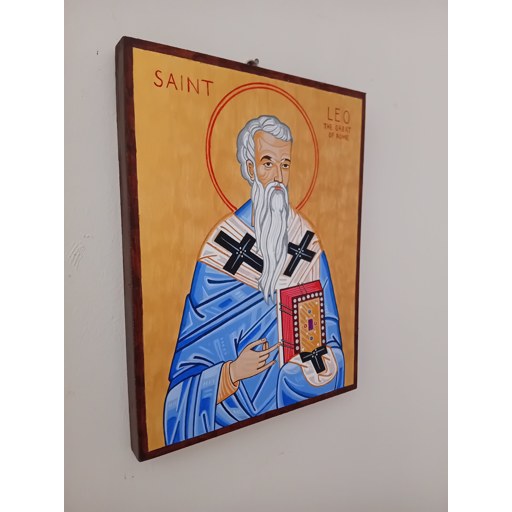
https://handmadeiconsgreece.myshopify.com/en-us/products/saint-leo-the-great
License: unknown
Leo
Saint- Life Span
- d. 461
- Feast Day
- 10 November
- Gender
- male
- Church
- Catholic
Places
Roles & Family
Biography
The name Leo is borne by many Christian figures, but the principal saint so called in Latin hagiography is Pope Leo I, later styled Leo the Great, Bishop of Rome from 440 until his death in 461. The Liber Pontificalis describes him as Tuscan by origin; a precise birthplace and an exact year of birth are not securely attested in contemporary sources, and later guesses should not be treated as fact. Before his election he was a prominent deacon of the Roman church under Popes Celestine I and Sixtus III, trusted with correspondence and with a diplomatic mission to Gaul. While he was still in Gaul, Sixtus III died and the Roman clergy and people elected Leo in absentia. He returned to be consecrated and began a pontificate that would shape both Western ecclesiology and the Christological settlement of the fifth century.
Leo’s most consequential theological act was the Tome addressed to Flavian of Constantinople, a letter that set out a two-nature Christology: Christ as one person in two natures, divine and human, without confusion or separation. That document was received with acclamation at the Council of Chalcedon in 451 and became a cornerstone of Chalcedonian orthodoxy, even as it also deepened the breach with those churches that rejected the council. In his sermons and letters Leo consistently asserted the unique responsibility of the Roman see as heir of Peter, and he intervened in the affairs of other Western churches, notably in Gaul and Illyricum, to enforce discipline and to claim appellate authority. His surviving corpus—dozens of sermons for the liturgical year and a large body of correspondence—is among the most important papal archives of late antiquity.
The same years were marked by the collapse of imperial security in Italy. In 452, according to later but widely repeated tradition grounded in near-contemporary report, Leo met Attila the Hun near the Mincio and, together with imperial envoys, obtained the Hunnic withdrawal from the peninsula; the relative weight of papal persuasion, plague, famine, and Eastern military pressure remains a matter of historical judgment. In 455, when the Vandal king Geiseric entered Rome, Leo negotiated to spare the city from fire and massacre, though it was still systematically looted. These episodes, whatever their exact diplomacy, fixed his later reputation as a protector of Rome in an age when the Western imperial court could no longer do so.
Leo died in Rome in 461 and was buried at Saint Peter’s; his relics were later translated within the basilica. Veneration of him as a saint is ancient and predates the medieval formal processes of beatification and canonization. In the Roman calendar his feast is kept on 10 November (the date long associated with his death); Byzantine usage commemorates him on 18 February. In 1754 Benedict XIV named him a Doctor of the Church. No religious order, marriage, or children are documented for him, and nothing reliable survives that would support a detailed list of later patronages attached specifically to this Leo rather than to other saints of the same name.