Leo III is a saint of the Catholic Church (d. 816). Leo III's feast day is celebrated on 12 June.
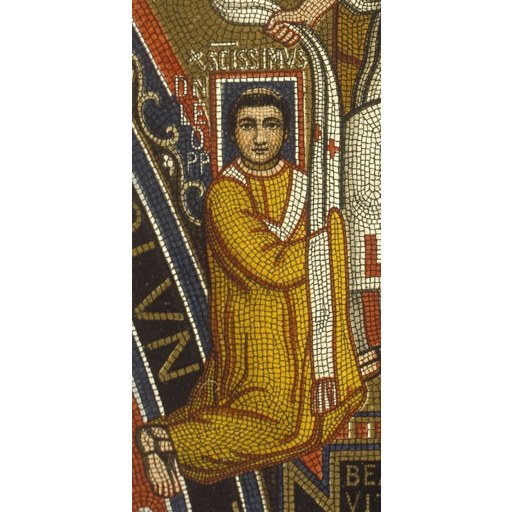
Various: Original: Unknown authorUnknown author Restoration: Ferdinando Fuga (1743)
License: Public domain
Leo III
Saint- Life Span
- d. 816
- Feast Day
- 12 June
- Gender
- male
- Church
- Catholic
Places
Relics & Where to Venerate
Location unknown
The bodily remains of Leo III are a first-class relic. Venerated at St. Peter's Basilica.
Roles & Family
Canonization
Biography
Pope Leo III, bishop of Rome from 795 until 816, was a native of Rome. The Liber Pontificalis names his father Azuppius and his mother Elizabeth and presents him as a man of comparatively modest origin, not a member of the great aristocratic clans that had dominated the Roman see in the previous generation. Before his election he served as priest of the title of Santa Susanna and as vestiarius, an official concerned with the papal treasury and vestments, under Pope Adrian I. On 26 December 795, the day after Adrian's death, the Roman clergy and people elected Leo; he was consecrated the following day. He at once sent Charlemagne, king of the Franks and Lombards and patrician of the Romans, the keys of the confession of Saint Peter and the banner of the city, thereby acknowledging Frankish protection over the Roman Church and its territories.
Leo's pontificate was soon marked by violent opposition from a faction of the Roman nobility connected with the family of his predecessor. On 25 April 799, during the procession of the Greater Litanies, he was assaulted by a group led by the primicerius Paschal and the sacellarius Campulus. The attackers tried to blind him and cut out his tongue, acts meant to render him canonically incapable of office, and dragged him to the monastery of Saint Erasmus on the Caelian Hill. He escaped, according to the sources with the help of the chamberlain Albinus, and took refuge first with the duke of Spoleto and then with Charlemagne at Paderborn. There the king heard both the pope and representatives of his accusers, who charged Leo with perjury and adultery among other crimes. Charlemagne sent Leo back to Rome under Frankish escort in late 799 and himself followed the next year.
In November 800 Charlemagne entered Rome. A synod of Frankish and Roman prelates and notables considered the accusations; because no one was held competent to sit in judgment on the Apostolic See, Leo was allowed to clear himself by a solemn oath of purgation, which he took on 23 December 800 in Saint Peter's. Two days later, on Christmas Day, during Mass, Leo crowned Charlemagne emperor. The act revived an imperial title in the West after more than three centuries and established a political order in which the Roman pontiff claimed a constitutive role in making an emperor. It also created lasting tension with the Byzantine court, which still regarded itself as the sole Roman Empire. In the years that followed, Leo used Frankish support and treasure to restore and decorate numerous Roman churches, including the Lateran and Saint Peter's.
Doctrinally, Leo is associated with the Western debate over the Filioque. He accepted the teaching that the Holy Spirit proceeds from the Father and the Son, yet he refused to insert the word into the Nicene-Constantinopolitan Creed as used at Rome. To fix the traditional text he had the Creed engraved in Greek and Latin, without the Filioque, on two silver shields placed in Saint Peter's. After Charlemagne's death in 814 a further conspiracy against Leo was uncovered in Rome; the pope had the plotters executed or exiled. He died in Rome on 12 June 816 and was buried in Saint Peter's Basilica. He was succeeded by Stephen IV. In 1673 Pope Clement X inscribed Leo III in the Roman Martyrology, and his feast is kept on 12 June.