Leoba is a saint of the Catholic Church (d. 782). Leoba's feast day is celebrated on 28 September. Leoba is the patron saint of Tauberbischofsheim.
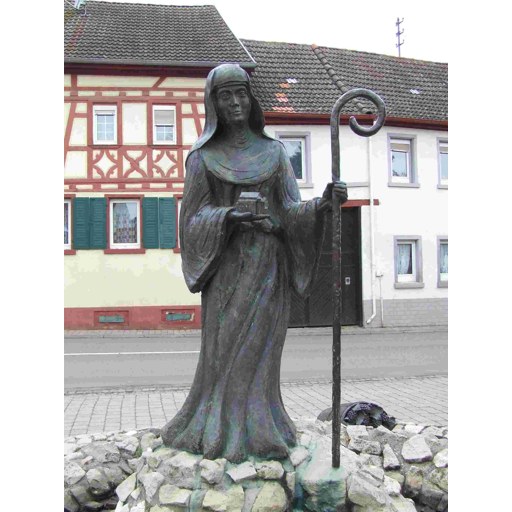
User:Kandschwar
License: CC BY-SA 3.0
Leoba
Saint- Life Span
- d. 782
- Feast Day
- 28 September
- Gender
- female
- Church
- Catholic
Places
Roles & Family
Religious Information
Patronage
Tauberbischofsheim
Biography
Leoba, also recorded as Leofgyth, Lioba, Leobgytha, or Truthgeba, was an Anglo-Saxon Benedictine nun, abbess, and missionary of the eighth century. She was born in the kingdom of Wessex to a family of the nobility. Her father was Dynne and her mother Aebbe, a kinswoman of the West Saxon missionary Winfrid, later known as Boniface. The principal early source for her life, the vita composed by Rudolf of Fulda in the ninth century, relates that Aebbe, who had long been childless, dreamed that a church bell rang within her bosom; a nurse interpreted the vision as a sign that she would bear a daughter destined for the service of God. In childhood Leoba was entrusted to the double monastery of Wimborne in Dorset, then governed by Abbess Tetta. There she received a rigorous formation in the Scriptures, the writings of the Fathers, canon law, and the monastic life, and she made her profession as a nun. Near-contemporary testimony presents her as exceptionally learned for her time.
In the middle decades of the eighth century Boniface, occupied with the organization of the church east of the Rhine, wrote to Tetta asking that Leoba and other experienced nuns be sent to support the mission among the Germans. Leoba accordingly left Wimborne for the Continent. Boniface established her as abbess of a new monastery at Tauberbischofsheim, from which she directed several dependent houses, among them a community at Schornsheim. She trained nuns, oversaw the education of girls of noble family, and maintained a reputation for strict yet measured discipline. Boniface regarded her with particular confidence. He granted her the unusual privilege of entering the male abbey of Fulda in order to confer on spiritual matters, presented her with his monastic cowl as a token of spiritual kinship, and expressed the desire that after death she should share his tomb. Bishops of the Frankish church sought her advice, and members of the court of Charlemagne, including Queen Hildegard, are said to have held her in honour and to have visited her.
In later life Leoba withdrew in part from active government of her houses and resided at Schornsheim. She died there on 28 September 782. Her body was conveyed to Fulda and interred in the abbey church, close to the resting place of Boniface, though not in the single grave he had wished to share with her. In the 830s Abbot Hrabanus Maurus of Fulda commissioned Rudolf to write her life, drawing on the recollections of nuns who had lived under her, so that her memory might be preserved and her example set before later generations. The vita attributes to her a number of miracles in life and after death, including deliverance from fire and storm; such accounts belong to the hagiographical tradition and cannot be independently verified. Her cult was established at Fulda and at Tauberbischofsheim, and she has been commemorated on 28 September. She remains especially associated with the monastery and town of Tauberbischofsheim, of which she is regarded as patron.