Leontius is a saint of the Catholic Church. Leontius's feast day is celebrated on 18 June.
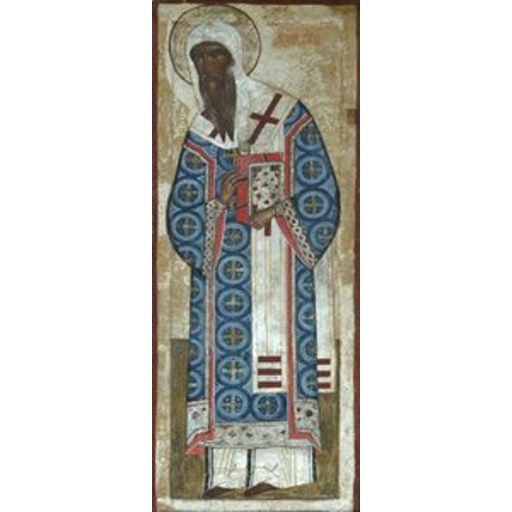
https://www.meisterdrucke.ie/fine-art-prints/Russian-icon./1187868/Saint-Leontius-of-Rostov,-16th-Century.html
License: unknown
Leontius
Saint- Feast Day
- 18 June
- Gender
- male
- Church
- Catholic
Places
Roles & Family
Biography
Saint Leontius, venerated together with the martyrs Hypatius and Theodulus, is an early Christian soldier-martyr associated with Tripoli in Phoenicia. The principal source for his story is the Greek hagiographical tradition, later summarized in the Byzantine synaxaria and reflected in the Roman Martyrology. According to that tradition, Leontius held a military command at Tripoli and lived as a Christian, practicing charity and converting others. The same accounts place his passion in the reign of the emperor Vespasian (69–79), under a governor named Hadrian. Critical historians regard the first-century dating and the names of the officials as products of later legend rather than as established fact; the acts themselves are of uncertain date and historical value. What is reasonably secure is that a martyr named Leontius was commemorated at Tripoli and that his feast entered the liturgical calendars of the Greek East.
The received narrative states that the governor sent the tribune Hypatius and the soldier Theodulus to arrest Leontius. Both men, after conversation and, in some versions, the witnessing of miracles, accepted Christianity. All three were then tortured. Hypatius and Theodulus were beheaded; Leontius was beaten to death after further interrogation and torment. These episodes follow the conventional pattern of early martyr acts—secret faith, denunciation, conversion of the arresting officers, and death under torture—and cannot be confirmed from independent documentary or archaeological evidence. No reliable source records Leontius’s place or year of birth, his family, or whether he was married or had children. He is not described as a monk or as a member of a religious order, nor as a bishop, patriarch, or pope.
Liturgical commemoration falls on 18 June in the Eastern Orthodox Church and on the same date in the Roman Martyrology, which locates the martyrdom at Tripoli in Phoenicia. Churches and icons in the Greek-speaking world attest to a continuing cult. A historically documented list of patronages (places, professions, or causes) attached specifically to this Leontius is not available in the standard reference works; local veneration at Tripoli and among Eastern Christians is implied by the calendar evidence. Because canonization in the early centuries was a matter of popular and episcopal cult rather than a papal process, there is no named canonizing authority.
The name Leontius was borne by several other ecclesiastical figures, and these must not be confused with the martyr of Tripoli. They include Leontius of Fréjus and Leontius of Autun in late antique Gaul, the sixth-century theologian Leontius of Byzantium, Leontius of Neapolis the Cypriot hagiographer, and Saint Leontius of Rostov in medieval Rus’. The present account concerns only the soldier-martyr of Tripoli. For him, almost every biographical particular beyond the existence of an early cult and a feast on 18 June remains within the realm of pious tradition rather than of verifiable history.