Leudwinus is a saint of the Catholic Church (d. 722). Leudwinus's feast day is celebrated on 29 September. Leudwinus is the patron saint of Mettlach.
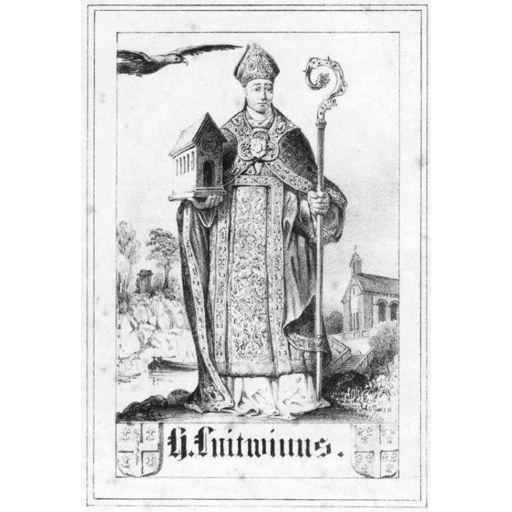
License: Public domain
Leudwinus
Saint- Life Span
- d. 722
- Feast Day
- 29 September
- Gender
- male
- Church
- Catholic
Places
Roles & Family
Religious Information
Patronage
Mettlach
Canonization
Biography
Leudwinus (also known as Liutwin, Leodewin, Lutwin, or Ludwin) was a Frankish nobleman and churchman of the late Merovingian period who served as bishop of Trier and is venerated as a saint. He lived in the later seventh and early eighth centuries in Austrasia, the northeastern portion of the Frankish realm, in the region of the Moselle. Traditional genealogies identify him as a son of Warinus, a count associated with Poitiers, and of Gunza of Metz, and as a kinsman—often called nephew or great-nephew—of Saint Basinus, bishop of Trier. These family links are widely repeated in later medieval and early modern accounts, but they rest on sources whose precision for the seventh century cannot be taken as certain. What is clearer is that Leudwinus belonged to the high aristocracy from which the Frankish episcopate of his age was commonly drawn.
According to the foundation legend of Mettlach, Leudwinus, while still a lay magnate, was hunting in the wooded country along the Saar when he lay down to rest and fell asleep. An eagle is said to have hovered over him and sheltered him from the sun. Taking the episode as a sign, he founded a monastery on the site, the Abbey of Mettlach, which adopted the Benedictine way of life and became the principal focus of his later cult. He is described as having entered the monastic community there for a time. Unlike later medieval bishops bound by a stricter discipline of celibacy, Leudwinus was married and had at least one son, Milo, who would succeed him in the see of Trier. The name of his wife is not securely preserved in early reliable sources.
In the last years of the seventh century or the first years of the eighth—often placed around 697—Leudwinus succeeded Basinus as bishop of Trier. Later listings sometimes style him archbishop and occasionally associate him as well with Laon or Reims, but his historically firm office is the episcopate of Trier, an important see on the Moselle with Roman roots and wide influence in Austrasia. As bishop he remained closely tied to Mettlach and to the ecclesiastical life of the middle Moselle and Saar. His tenure fell in a period of political change, as Merovingian royal authority waned and the power of the Pippinid mayors of the palace, ancestors of the Carolingians, increased. The Frankish church of this generation still mixed aristocratic family interest, monastic foundation, and episcopal office in ways that later reform would try to separate.
Leudwinus died on 29 September in a year given by most authorities as 722, though 723 also appears. One tradition places his death at Reims; his body was buried at Mettlach Abbey, where his tomb attracted veneration. His son Milo followed him as bishop of Trier, a succession that later writers sometimes judged harshly because Milo was remembered more as a secular magnate than as a pastor. Leudwinus’s feast is observed on 29 September. He is the patron saint of Mettlach. Like the great majority of saints of the early medieval Latin West, he was honored by local cult and liturgical commemoration rather than by a formal process of papal canonization of the kind that developed in later centuries; Catholic reference works therefore class his recognition as pre-congregation. The abbey he founded was dissolved in the eighteenth century, but the town of Mettlach and the former abbey church have continued to preserve his memory.