Ælfgifu of Shaftesbury is a saint of the Catholic Church (d. 944). Ælfgifu of Shaftesbury's feast day is celebrated on 18 May.
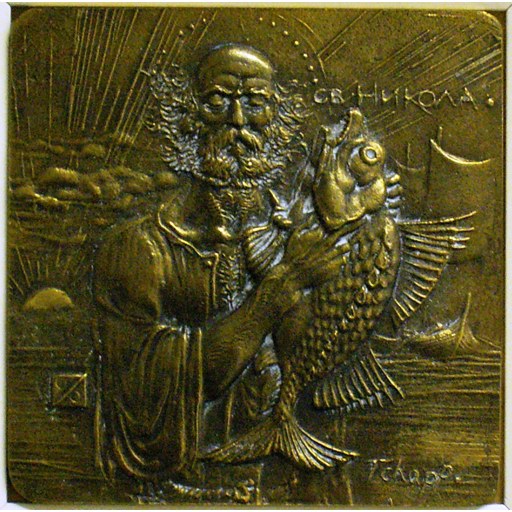
https://en.wikipedia.org/wiki/Icon
License: unknown
Ælfgifu of Shaftesbury
Saint- Life Span
- d. 944
- Feast Day
- 18 May
- Gender
- female
- Church
- Catholic
Places
Relics & Where to Venerate
Location unknown
The bodily remains of Ælfgifu of Shaftesbury are a first-class relic. Venerated at Shaftesbury Abbey.
Roles & Family
Religious Information
Biography
Ælfgifu of Shaftesbury was a tenth-century Anglo-Saxon queen, the first wife of King Edmund I of England (reigned 939–946). The year and place of her birth are not recorded in surviving sources. She was the daughter of Wynflæd, a wealthy noblewoman whose will is an important witness to female landholding and religious patronage in tenth-century southern England; Wynflæd made gifts to several minsters, including Shaftesbury Abbey. Ælfgifu married Edmund, a son of King Edward the Elder, probably during the 930s, before he became king. They had two sons, Eadwig and Edgar, both of whom later ruled as kings of the English.
Contemporary evidence for Ælfgifu's life as queen is limited. Later writers, especially the twelfth-century historian William of Malmesbury, described her as outstanding in piety and in generosity to the poor and to the Church. She died in 944, while Edmund was still on the throne, and was buried at Shaftesbury Abbey in Dorset, a nunnery founded in the late ninth century by King Alfred the Great. Shaftesbury became the centre of her cult. Edmund subsequently married Æthelflæd of Damerham. When Edmund was killed in 946, the crown passed to his brother Eadred; only after Eadred's death in 955 did Ælfgifu's elder son Eadwig succeed, followed in 959 by her younger son Edgar.
Ælfgifu was venerated as a saint from the later tenth century. In the period before the development of a formal papal canonization process, her sanctity was expressed through local cult, the honouring of her tomb by the community at Shaftesbury, and the interest of the West Saxon dynasty in a holy royal ancestor. Her feast came to be observed on 18 May. Her son Edgar, whose reign is associated with the climax of the Benedictine reform in England, and later kings continued to favour Shaftesbury. The abbey's prestige was bound up with possession of the relics of Saint Ælfgifu.
Although the sources do not support a detailed personal biography, Ælfgifu occupies a secure place in the dynastic history of tenth-century England as the mother of two kings and as an early example of a West Saxon queen whose memory was cultivated as that of a saint. What can be known of her rests on genealogies and king-lists, her mother's will, the site of her burial and cult, charters connected with Shaftesbury, and the retrospective accounts of historians such as William of Malmesbury. She illustrates both the political importance of royal marriage and motherhood and the ways in which piety, patronage, and royal status could combine to produce a lasting religious cult in Anglo-Saxon England.