Libert of Saint-Trond is a saint of the Catholic Church (d. 783). Libert of Saint-Trond's feast day is celebrated on 14 July.
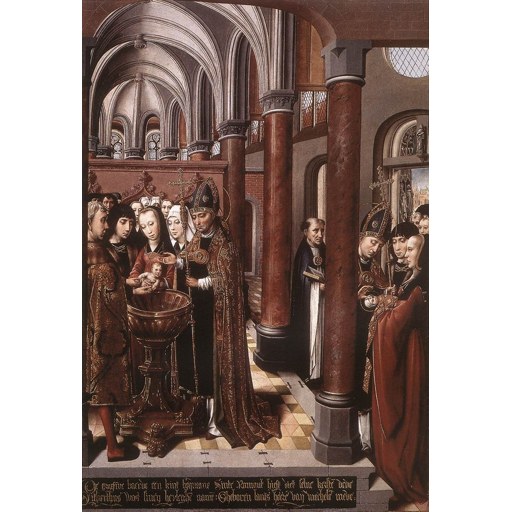
Colijn de Coter
License: Public domain
Libert of Saint-Trond
Saint- Life Span
- d. 783
- Feast Day
- 14 July
- Gender
- male
- Church
- Catholic
Places
Roles & Family
Religious Information
Biography
Libert of Saint-Trond, also known as Libertus, is an eighth-century monk-martyr of the Low Countries whose life is known almost entirely from later hagiographical tradition rather than from contemporary charters or annals. According to those accounts he was born at Mechelen (Malines), then a settlement in the Frankish kingdom of Austrasia in the region that is now Belgium. He is said to have been sent for his education to the abbey of Saint-Trond (Sint-Truiden) in Hesbaye, a monastery founded in the seventh century by Saint Trudo on his family estate and already, by the eighth century, an important Benedictine house in the Meuse–Demer country. The sources do not preserve a reliable year of birth, the names of his parents, or any details of his childhood beyond this association with Mechelen and with the abbey school.
Formed in that community, Libert entered monastic life under the Rule of Saint Benedict and remained a monk of Saint-Trond. No contemporary witness records offices he may have held, writings he may have left, or missionary journeys. His memory is bound to the abbey itself and to a violent death that later writers described as martyrdom. Some later traditions, probably by grouping local Mechelen saints of the same generation, have linked him with Saint Rumold (Rombaut) of Mechelen, an Irish or Insular missionary bishop martyred in the 770s; that connection is not secured by early independent evidence and should be treated as possible hagiographical association rather than established biography.
Tradition places his death in 783. He is said to have been killed by invading raiders while at prayer in the church. Medieval and early modern compilers often called the attackers “Huns,” a conventional and anachronistic label in Western martyrologies for pagan or foreign enemies; the historical Huns had vanished centuries earlier. The precise identity of the assailants—whether Saxon or other frontier raiders in the age of Charlemagne’s Saxon wars, a local outbreak of violence, or a later legendary overlay—cannot be established from reliable eighth-century evidence. No independent Frankish annal confirms an attack on Saint-Trond in that year. The date 783 remains the received traditional year of death in martyrologies and modern notices, not a date fixed by a contemporary obituary.
Devotion to Libert was essentially local. He was commemorated as a Benedictine monk and martyr in connection with the abbey of Saint-Trond and, by origin, with Mechelen. His feast is kept on 14 July. Like many saints of the early medieval Low Countries he was recognized by cult and liturgical commemoration rather than by a formal papal canonization of the later medieval or Tridentine type. Surviving evidence does not record a distinctive list of patronages, nor a securely identified tomb beyond the presumption of burial associated with the abbey. Historians therefore treat the outline with caution: the core that can be stated is that an eighth-century monk of Saint-Trond named Libert was honoured as a martyr, that later tradition placed his birth at Mechelen and his death in 783, and that his cult was observed on 14 July.