Linus is a saint of the Pre-Schism (Universal) Church. Linus's feast day is celebrated on 23 September.
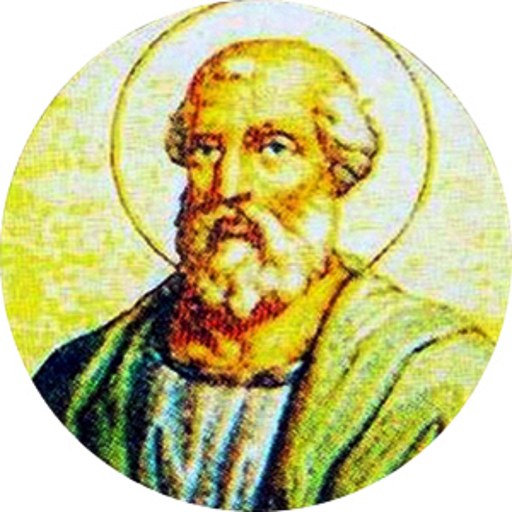
Unknown authorUnknown author
License: Public domain
Linus
Saint- Feast Day
- 23 September
- Gender
- male
- Church
- Pre-Schism (Universal)
Places
Relics & Where to Venerate
Location unknown
The bodily remains of Linus are a first-class relic. Venerated at St. Peter's Basilica.
Roles & Family
Canonization
Biography
Linus stands in the earliest surviving Roman succession lists as the first bishop of Rome after the apostle Peter. Writing toward the end of the second century, Irenaeus of Lyons reports in Against Heresies that the apostles Peter and Paul, having founded and organized the church in Rome, entrusted the episcopate to Linus, whom Irenaeus identifies with the Linus named among the Roman Christians who send greetings in the Second Epistle to Timothy. Eusebius of Caesarea, in the early fourth century, repeats this order and states that Linus held the office for twelve years; Jerome’s On Illustrious Men gives a closely related figure of eleven years. These notices, together with the list associated with Hegesippus, show that by the late second century Linus was firmly established in the memory of the Roman church as Peter’s immediate successor. They do not, however, preserve any contemporary Roman document from Linus’s own lifetime.
Personal details are almost entirely lacking in the early witnesses and must be treated with caution when they appear later. The Liber Pontificalis, a Roman compilation of papal biographies whose earliest form belongs to the sixth century, describes Linus as an Italian, a native of Volterra in Tuscany, and the son of a man named Herculanus. The same source ascribes to him a regulation that women should have their heads veiled in church, a rule that closely reflects the teaching of Paul in First Corinthians and may be a retrospective attribution rather than an independent first-century decree. No reliable source records a year of birth. Ancient calculations of his death diverge: proposed dates fall in the later 70s of the first century, commonly around 76 to 80, but they rest on later synchronisms, not on dated inscriptions or administrative records. Whether the Linus of the Pastoral Epistles is the same person as the Roman bishop remains a traditional identification rather than a fact that can be proved.
The order of the first Roman bishops was not uncontested even in antiquity. Tertullian, writing in North Africa in the early third century, asserted that Clement of Rome was ordained by Peter, a tradition that would make Clement, not Linus, the immediate successor. Catholic and many other later lists follow Irenaeus in the sequence Peter, Linus, Anacletus (also called Cletus), and Clement, yet the discrepancy indicates that the first-century succession was reconstructed from memory and competing local traditions. Modern historians further note that the fully monarchic episcopate may have developed only gradually at Rome; some argue that the city was led in the later first century by a group of presbyters rather than by a single bishop in the later sense. In that interpretation, the name Linus would still belong to a prominent Roman leader of the apostolic generation, but the title and powers later associated with the papacy should not be read back uncritically into his lifetime. No genuine literary work of Linus is extant. Apocryphal narratives of the martyrdoms of Peter and Paul that circulated under his name are later compositions.
Later legend made Linus a martyr and placed his tomb on the Vatican Hill beside that of Peter, as the Liber Pontificalis and medieval martyrologies affirm. Irenaeus, however, does not describe him as a martyr, and there is no first-century evidence of a Roman persecution at the traditional date of his death that would confirm such an end. An epitaph bearing the name Linus, reported from Vatican excavations in the early seventeenth century, has been connected with him, but the stone may preserve only part of a longer name and cannot be regarded as a secure identification. The Latin Church has commemorated him on 23 September; he is still named in the Roman Martyrology, although his feast was dropped from the General Roman Calendar in the reform of 1969. Eastern Christian calendars have also kept his memory, sometimes on the same date and sometimes among groups of early Roman bishops or of the Seventy Apostles. He was venerated as a saint from the earliest period of public cult, long before the later formal processes of beatification and canonization, and he is therefore classed as a saint of the pre-congregation era. Specific later patronages of places, trades, or causes are not securely attached to his name. Historically he remains a figure known almost exclusively through the second-century Roman succession tradition and through the later legendary overlay that sought to give the second pope a biography, a martyr’s crown, and a tomb beside the apostle he was believed to have followed.