Liphardus is a saint of the Catholic Church. Liphardus's feast day is celebrated on June 3. Liphardus is the patron saint of Meung-sur-Loire.
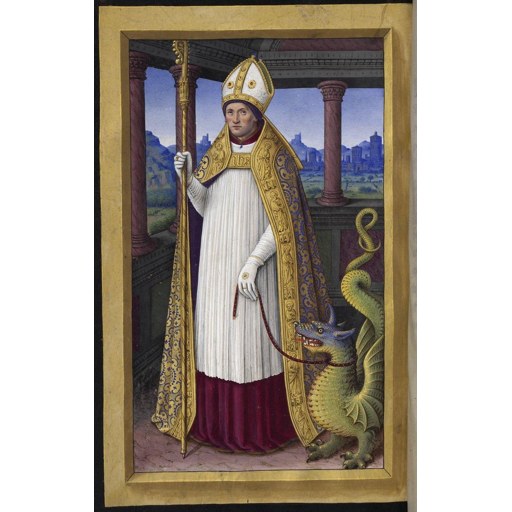
Jean Bourdichon
License: Public domain
Liphardus
Saint- Feast Day
- June 3
- Gender
- male
- Church
- Catholic
Places
Roles & Family
Patronage
Meung-sur-Loire
Biography
Saint Liphardus (also known as Lifard, Liphard, or Lifardus) was a sixth-century hermit, priest, and abbot associated with the Loire valley in the region of Orléans, in Merovingian Gaul. The principal source for his life is a later hagiographical vita rather than any contemporary chronicle; Gregory of Tours, the chief historian of sixth-century Gaul, does not mention him. According to that traditional account, Liphardus was born in Orléans of a family of high, even senatorial, rank. He was trained in the law and practised as an advocate, gaining a considerable reputation in the courts while still a young man. At some point in early adulthood he renounced this secular career, together with the prospects of wealth and honour that accompanied it, in order to live as a Christian ascetic.
He established himself as a hermit at Magdunum, the Gallo-Roman site that later became the town of Meung-sur-Loire, on the Loire a short distance southwest of Orléans. There he was joined by a companion named Urbicius (Urbice), who is likewise honoured as a saint and who, according to the same tradition, became his disciple and eventually his successor. As other followers gathered around the hermitage, Liphardus received priestly ordination and organised the group into a monastery, of which he served as the first abbot. The foundation at Meung-sur-Loire is thus ascribed to him and belongs to the wave of monastic settlements that marked the religious landscape of sixth-century Gaul, independently of the Benedictine rule, which had only recently been composed in Italy and had not yet become the standard in the Frankish kingdoms.
No contemporary document records the date of his death. Later liturgical and hagiographical tradition places it about the middle of the sixth century, commonly given as around the year 550. He was buried at the monastery he had founded. In the Middle Ages the community was transformed into a collegiate chapter of canons, and a substantial church—the present Collégiale Saint-Liphard, combining Romanesque and later Gothic work—was erected at Meung-sur-Loire as the shrine of his tomb. His relics were kept and venerated there for centuries until they were scattered or destroyed in 1562 during the Wars of Religion, when Huguenot forces sacked the town. The Roman Martyrology commemorates him on 3 June as a priest who, after living as a hermit, founded a monastery at Meung-sur-Loire. He is the local patron of that town.
Medieval legend, as so often in the lives of early monastic saints, added colourful miracles that cannot be historically verified. One cycle of stories describes a dragon or monstrous serpent that infested the Loire and terrorised the neighbourhood; Liphardus is said to have overcome the beast by the sign of the cross or with his staff, in some versions after it had swallowed his disciple Urbicius. Another motif attributes to him the miraculous discovery of a spring. These episodes belong to the common repertoire of early medieval hagiography and should not be treated as factual biography. What can be said with caution is that a monastic founder named Liphardus was remembered at Meung-sur-Loire from an early period, that a church and chapter were dedicated to him, and that his cult remained a feature of the diocese of Orléans throughout the Middle Ages. Beyond that outline, the details of his life rest on tradition rather than on independently datable sixth-century evidence.