Lomer is a saint of the Catholic Church (d. 593). Lomer's feast day is celebrated on 19 January.
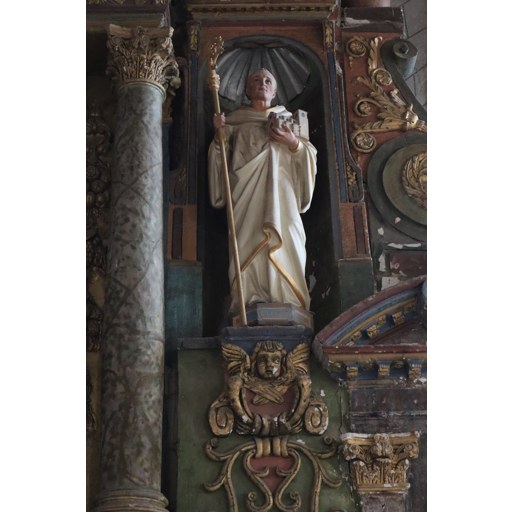
GO69
License: CC BY-SA 4.0
Lomer
Saint- Life Span
- d. 593
- Feast Day
- 19 January
- Gender
- male
- Church
- Catholic
Places
Roles & Family
Biography
Saint Lomer, known in Latin as Launomarus or Laudomarus and in French as Lomer or Laumer (also Laudomarcus), was a priest, hermit, and abbot in sixth-century Frankish Gaul. He is remembered as the founder and first abbot of the monastery of Corbion in the forest of Perche, in western France. Almost nothing about him can be established from strictly contemporary documents; the outline of his life rests on later hagiography, local monastic tradition, and the liturgical calendars that preserved his cult. The date of his death is traditionally given as 19 January 593. No reliable source records a year of birth, and figures sometimes circulated in modern notices cannot be reconciled with the rest of the traditional story.
He is said to have been born of poor parents in the countryside of the Chartres region, a place later identified as Neuville-la-Mare in what is now the department of Eure-et-Loir. In his youth he worked as a shepherd. His piety attracted the attention of Leobinus (Saint Lubin), bishop of Chartres, who took him into his household, had him educated, and ordained him to the priesthood. Leobinus died around the middle of the sixth century. If the tradition that Lomer was ordained by him is accepted, Lomer’s clerical life must have begun well before the year usually assigned to his own death, which would make him an old man by 593. After some years of priestly service he withdrew from ordinary pastoral work to live as a hermit in the wooded country of Perche, west of Chartres.
Disciples gathered around the hermit, and the settlement developed into a monastic community. Lomer founded the monastery of Corbion (Corbionense monasterium), generally identified with the later site of Moutiers-au-Perche in the present department of Orne. As its first abbot he was credited with austerity of life, miracles, and the spiritual formation of his monks. The house belonged to the world of early medieval Gallic monasticism; it should not be assumed, on later evidence, that it already followed the Rule of Saint Benedict in Lomer’s own lifetime. The Benedictine identity associated with his name is chiefly that of the later abbey at Blois that housed his relics.
Toward the end of his life he went to Chartres, where he died. His body was taken back to Corbion for burial. In later centuries, especially during the ninth-century disruptions associated with Viking raids, the community and the saint’s relics were displaced. The cult became centered at Blois, where a Benedictine abbey dedicated to Saint-Laumer (Saint-Lomer) received the relics and promoted his memory; a church in Blois long associated with that dedication continued to mark the site of the translation. He is commemorated on 19 January in the Roman Martyrology and in local calendars. He was never the object of a formal papal canonization of the later medieval type; his sainthood rests on ancient local veneration, subsequently recognized by inclusion in the martyrology.