Love of Rome is a saint of the Catholic Church. Love of Rome's feast day is celebrated on 17 September.
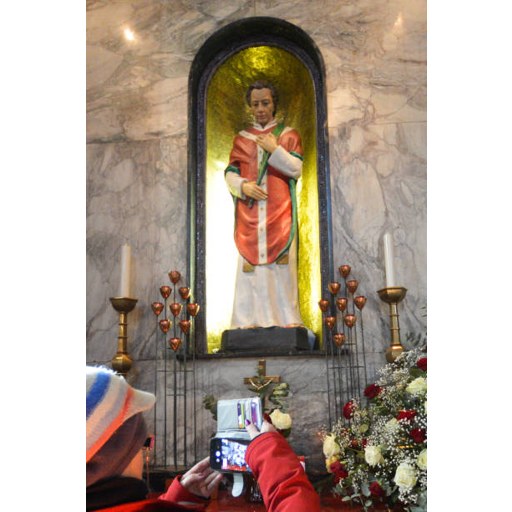
https://gettyimages.com/photos/saint-valentine-of-rome
License: unknown
Love of Rome
Saint- Feast Day
- 17 September
- Gender
- female
- Church
- Catholic
Places
Roles & Family
Biography
The saint known in English as Love of Rome is the youngest of three sister-martyrs commemorated together with their mother Sophia in both Eastern and Western Christian tradition. She is called Agape in Greek, Caritas in Latin, Charity in many English sources, and Lyubov in the Slavic churches; all of these names denote the theological virtue of love. The legend places the family in Italy in the second century, during the reign of the emperor Hadrian (117-138). Sophia, a Christian widow, is said to have named her daughters Faith, Hope, and Love after the three virtues named by the Apostle Paul. Love is described in the passio as nine years old at the time of her death, her sisters as twelve and ten. Historians of hagiography, from the Bollandists onward, have observed that the story reads as an allegory of Wisdom and her children the theological virtues, and that no independent contemporary evidence confirms the existence of these four persons as historical individuals. The cult, however, is of considerable antiquity.
According to the received narrative, Sophia raised her daughters in Italy in an unconcealed Christian piety. Their fame reached Rome, and the family was brought before Hadrian, who sought to turn the children from Christ, first by persuasion and promises and then by intimidation. Each sister was examined and refused to sacrifice to the pagan gods. The legendary acts then describe a succession of tortures. Faith, the eldest, was subjected to scourging and other torments and finally beheaded. Hope underwent similar sufferings and was likewise beheaded. Love, the youngest, is said to have been bound, beaten, and cast into a furnace, remaining constant throughout, and was then beheaded. These episodes belong to the conventional repertoire of late antique and medieval martyr acts and cannot be treated as historical reportage. They served to present the three virtues as victorious even in the persons of children.
The legend continues that Sophia was not put to death with her daughters. She was allowed to recover their bodies and to bury them beside the Aurelian Way, about twelve stadia from Rome. She remained at the tomb in prayer and died there three days later, and was buried with them. Later centuries produced competing claims to relics. In 777 relics identified as those of Sophia and her daughters were recorded as translated to Eschau in Alsace, where a church of Saint Trophimus became a regional shrine; the cult in the Rhineland and in France owes much to that translation. Other relics have been associated with churches in Rome. None of these claims can be verified by modern historical methods, and the original burial on the Via Aurelia itself is known only from the legendary text.
Liturgical commemoration diverges by rite. The Eastern Orthodox Church, and Eastern Catholics who follow the Byzantine calendar, keep the feast of Sophia and her three daughters on 17 September; in Russian, Ukrainian, and other Slavic cultures the day is a well-known name day for Vera, Nadezhda, Lyubov, and Sofia. The Roman Martyrology entered the three sisters on 1 August and a Saint Sophia, widow, on 30 September, a splitting of the group that reflects Western medieval calendar practice. The Golden Legend and similar collections transmitted the story in the Latin Middle Ages. Love of Rome is remembered as a child virgin martyr: the tradition gives her no spouse, no children, no religious order, and no hierarchical office. No historically secure year of birth or death can be assigned. Her patronage is not defined by a single papal or synodal decree; she is honored as a personification of Christian charity and as one of a family of child martyrs whose memory has been kept, especially in the Christian East, for many centuries.