Lucian is a saint of the Catholic Church (d. 312). Lucian's feast day is celebrated on January 7.
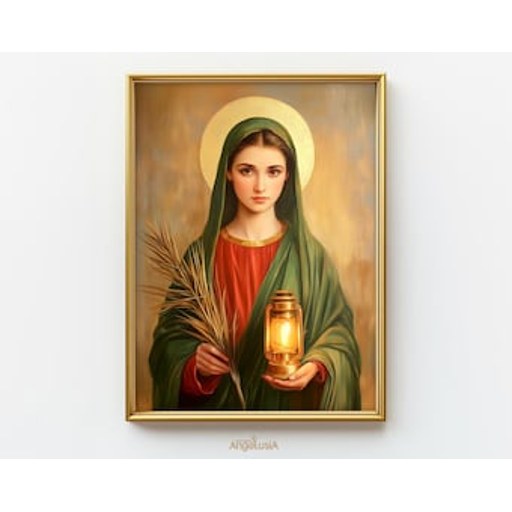
https://etsy.com/listing/1301566965/saint-lucy-icon-print-sacred-image-icons
License: unknown
Lucian
Saint- Life Span
- d. 312
- Feast Day
- January 7
- Gender
- male
- Church
- Catholic
Places
Roles & Family
Biography
Saint Lucian of Antioch was a Christian priest, biblical scholar, and martyr of the late third and early fourth centuries. He was born at Samosata in Commagene, a region of Roman Syria, probably around the middle of the third century. After early studies, including a period at Edessa under a teacher named Macarius according to later tradition, he made his home in Antioch, the great Christian center of the Roman East. There he was ordained a presbyter and became the leading figure of a school of scriptural interpretation. Ancient writers describe him as a man of considerable learning in both Greek literature and the sacred books, and as an ascetic of austere personal life.
Lucian is associated with a careful recension of the Greek text of the Bible. Later tradition credited him with producing a corrected edition of the Septuagint and of the New Testament that circulated widely in the churches of Syria and Asia Minor and left a mark on the so-called Byzantine or Antiochene textual tradition. Modern scholarship treats the precise scope of his editorial work with caution, but it is clear that Antioch in his generation was a major center of biblical study and that his name became attached to an influential form of the Greek Scriptures. He taught students who would later occupy important places in the Eastern churches.
During the Great Persecution that began under the Emperor Diocletian, Lucian was imprisoned for his faith. He was released after a time, but was arrested again in the renewed persecution under Maximinus Daia. Brought to Nicomedia, then an imperial residence in Bithynia, he was held in prison and subjected to torture. Early accounts state that he died there after a public confession of Christian faith, either from starvation, having refused food that had been offered to idols, or as a result of his sufferings. His death is placed by the majority of historical sources in the year 312. Western calendars commemorate him on 7 January; many Eastern calendars keep his feast on 15 October.
Lucian’s posthumous reputation was complicated by the fact that several later opponents of the Nicene definition, including Arius and Eusebius of Nicomedia, claimed to have been his disciples and invoked his authority. This association led some fourth-century and later writers to treat him as a forerunner of Arian theology. Other sources, including accounts of his martyrdom, present him as having confessed the full divinity of Christ. The historical evidence does not permit a simple resolution of his exact doctrinal position. Despite the controversy, both the Eastern Orthodox and the Roman Catholic churches have continued to venerate him as a martyr. Tradition holds that his body was recovered and buried at Drepanum in Bithynia, a town later refounded as Helenopolis, where a church was dedicated to him.
His school at Antioch helped to shape a style of biblical exegesis that emphasized the literal and historical sense of Scripture, in contrast to the more allegorical methods associated with Alexandria. That Antiochene approach would influence later theologians of the fourth and fifth centuries. Lucian remains an important, if partly enigmatic, figure at the junction of biblical scholarship, the last great Roman persecution of Christians, and the doctrinal conflicts that followed the peace of the Church.